

 Secretariat has urged South Sudan to accelerate implementation of its EAC commitments and position itself as a strategic hub for investment, production, manufacturing and regional value chains.)
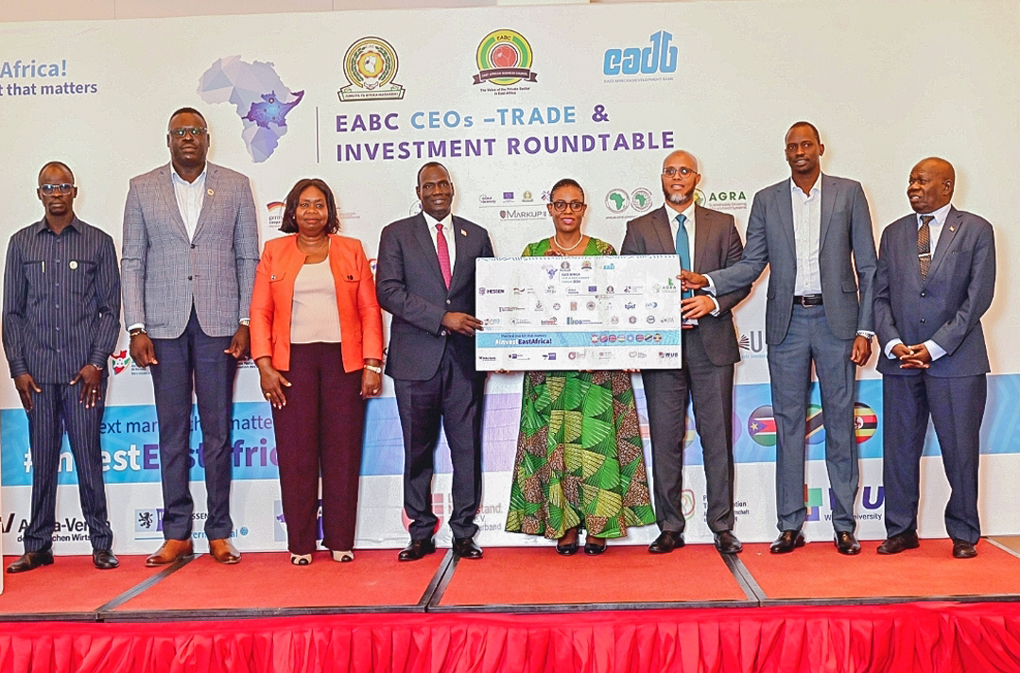
The East African Community (EAC) Secretariat has urged South Sudan to accelerate implementation of its EAC commitments and position itself as a strategic hub for investment, production, manufacturing and regional value chains.
The call was made on Monday during the EABC CEO’s Trade and Investment Roundtable in Juba, convened by the East African Business Council (EABC) in partnership with the South Sudan Chamber of Commerce, Industry and Agriculture (SSCCIA) and GIZ.
The roundtable brought together government officials, private-sector leaders and regional stakeholders to identify practical measures for unlocking trade and investment opportunities in South Sudan.
Hon. Annette Mutawe Ssemuwemba, Deputy Secretary General of the EAC Secretariat, called for coordinated and consistent implementation of South Sudan’s EAC commitments. She also commended President Salva Kiir Mayardit for assenting to the EAC Treaty on 22 April 2026.
She highlighted progress in strengthening South Sudan’s legal and institutional framework for regional integration, including the EAC Treaty Establishing Act, 2026, customs reforms and the Nimule–Elegu One Stop Border Post.
Ssemuwemba urged further implementation of key EAC instruments, including the Customs Union, Single Customs Territory, Common External Tariff, Rules of Origin and Common Market commitments.
She said policy predictability, removal of non-tariff barriers, harmonised procedures and efficient trade facilitation would be critical to reducing the cost of doing business and attracting investment. She also emphasised the importance of integrating services such as transport, finance, insurance, ICT, tourism and professional services.
EABC Chairperson Hon. Amb. John Lual Akol Akol called for stronger government–private-sector collaboration to remove barriers to trade and investment and strengthen South Sudan’s participation in the wider EAC market.
“We must move from regional commitments to practical action by removing barriers, improving connectivity and creating an environment where businesses can trade, invest and grow across East Africa,” Akol said.
He identified the resolution of non-tariff barriers, tax and regulatory harmonisation, improved transport and border procedures, access to finance and stronger regional value chains as key priorities for improving South Sudan’s competitiveness.
Representing the Undersecretary, Mr. John Deng, Acting Director General for Social and Political Affairs, said South Sudan has waived the Alien Pass registration requirement for EAC citizens. He encouraged businesses to report non-tariff barriers, including unlawful roadblocks and other impediments, which affect the efficiency of regional trade corridors.
The panel discussion, “South Sudan’s Integration into the EAC and Private Sector Perspectives on Boosting Intra- and Extra-EAC Trade and Investment,” underscored the significant opportunities presented by deeper regional integration.
With faster implementation of its EAC obligations, South Sudan could improve trade facilitation, lower the cost of doing business and create a more predictable environment for investors.
The country has considerable potential in agriculture, livestock, fisheries, renewable energy, ICT, tourism, logistics and manufacturing. Developing these sectors could support economic diversification, value addition, regional trade and employment creation.