


By Ginaba Lino
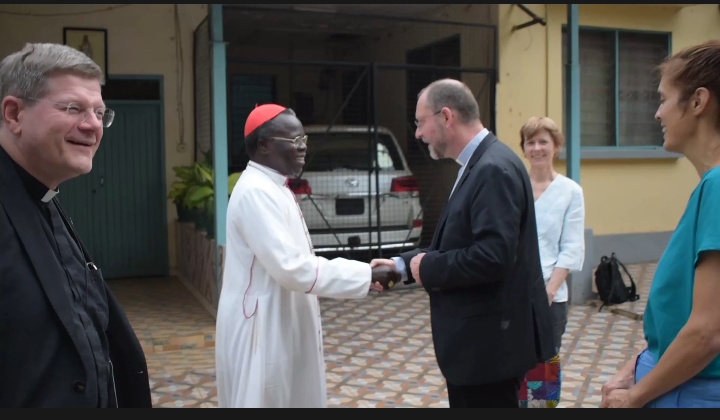
A high-level delegation from Germany’s Catholic Church development agency Misereor met Cardinal Stephen Ameyu Martin Mulla, who is also the President of the Sudan and South Sudan Catholic Bishops’ Conference, in Juba to gain a deeper understanding of the country’s long and fragile peace process and the Catholic Church’s contribution to rebuilding a nation emerging from decades of conflict.
The Misereor team, visiting South Sudan for the first time, includes Archbishop Stefan Burger of Freiburg, Germany; Fr. Dr. Andreas Frick, Director of Misereor; and the accompanying delegation, which includes Katherina Goette, Misereor Desk Officer for South Sudan; Uwe Bergmeier, Head of Dialogue and Partnership Services; and Ita Reilly, Misereor Translator.
The meeting provided an opportunity for the German delegation to hear directly from South Sudan’s Catholic leadership about the country’s political transition, humanitarian pressures, youth aspirations and the Church’s continued engagement in education, healthcare, peacebuilding and reconciliation.
Archbishop Stefan Burger said their visit was an opportunity to understand South Sudan beyond the predominantly negative picture often presented internationally.
“I hear a lot of different impressions. South Sudan is a country that is unknown to me. All I hear are problems, difficulties, conflicts and disputes — a country in turmoil,” Archbishop Burger said.
He asked Cardinal Ameyu to explain not only the challenges facing the world’s youngest nation, but also the positive developments that receive less international attention.
“I would like to know more about the country, not only the negative things, but also the positive side of the country,” he said. The Catholic Church has played a prominent role in South Sudan’s peace and reconciliation efforts, repeatedly urging political leaders to implement peace commitments and prioritize the needs of ordinary citizens.
Cardinal Ameyu said the implementation of the peace agreement remains incomplete, but the country has experienced a degree of relative peace compared with previous periods of widespread conflict.
He said the Church has consistently remained at the forefront of efforts to promote peace, reconciliation and stability.
“We are trying our level best to bring about stability,” he said. “The Church has always been at the front line of seeking peace, urging the leaders of the government to bring peace to the people and reconciliation.”
The discussion comes as South Sudan approaches another critical phase in its political transition, with elections scheduled for 22 December 2026.
The Catholic leadership expressed hope that the electoral process could contribute to greater stability and provide an opportunity for the country to consolidate peace.
The meeting also highlighted the important role played by the Catholic Church in providing essential social services in South Sudan.
The bishops highlighted some of the challenges the Catholic Church is facing in providing services to the people, adding that schools and health facilities have at times been forced to close because the Church lacks sufficient resources to meet operational costs.
He stressed that the economic crisis, including the sharp disparity between the South Sudanese pound and the United States dollar, has made it increasingly difficult to operate institutions dependent on imported goods and external support.
“We struggle as a Church to feed the people, to educate them and to give them help. That is the greatest problem,” he said.
The discussions offered an opportunity to better understand the realities behind South Sudan’s often negative international image and to listen directly to Church leaders working at the community level.
The delegation’s visit is also focused on seeing firsthand projects supported by Misereor and understanding the challenges confronting communities and Church institutions.
The visit reflects Misereor’s broader partnership with the Catholic Church and other local actors working to strengthen communities affected by conflict, displacement, poverty and climate-related challenges.
The South Sudanese bishops stressed that international partnerships remain essential as the country continues its difficult transition from conflict towards peace and development.