
 have signed a three-year bilateral health cooperation agreement worth more than 166 million US dollars, marking a significant step in strengthening the country's health sector while reinforcing Washington's demand for greater government accountability.)
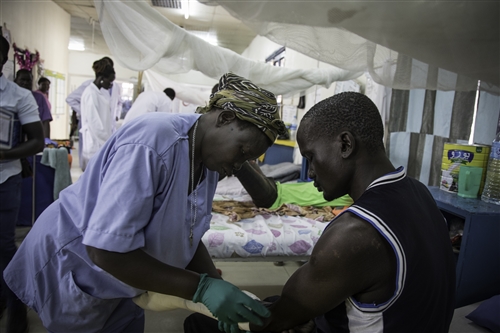
CRN News Desk|The United States and South Sudan’s Revitalized Transitional Government of National Unity (RTGoNU) have signed a three-year bilateral health cooperation agreement worth more than 166 million US dollars, marking a significant step in strengthening the country’s health sector while reinforcing Washington’s demand for greater government accountability.
The Memorandum of Understanding (MOU), signed on June 25 under the Trump Administration’s America First Global Health Strategy, commits the United States to provide more than 146 million dollars in health assistance, while the Government of South Sudan will contribute nearly 20 million dollars from its own public revenues.
According to the U.S. Department of State, the agreement aims to strengthen South Sudan’s response to infectious diseases, including HIV/AIDS, tuberculosis, malaria, and emerging public health threats such as Ebola.
Under the agreement, the South Sudanese government has pledged to finance essential health services, pay salaries for health workers, maintain critical infrastructure such as vaccine cold-chain systems, and improve transparency and reporting in the management of health resources.
The U.S. says the new arrangement introduces a more accountable model of foreign assistance by requiring both governments to measure progress through jointly agreed performance indicators to ensure aid reaches intended beneficiaries.
The partnership also seeks to improve disease surveillance and emergency response, with both countries committing to detect and respond to infectious disease outbreaks within seven days of their emergence. U.S. officials said the agreement comes at a critical time as countries in the region continue to monitor the threat posed by Ebola outbreaks.
The United States has remained one of South Sudan’s largest humanitarian and development partners for more than two decades. Washington played a key diplomatic role in supporting the country’s independence in 2011 and has continued to provide billions of dollars in humanitarian relief, health services, food assistance, governance support and peacebuilding programs.
However, relations between the two countries have at times been strained over delays in implementing political reforms, concerns about corruption, human rights violations and repeated extensions of South Sudan’s political transition.
Despite these challenges, the United States continues to support South Sudan’s stability while urging its leaders to implement reforms necessary for lasting peace and democratic governance.
The latest health agreement comes as South Sudan continues implementing the 2018 Revitalized Agreement on the Resolution of the Conflict in the Republic of South Sudan (R-ARCSS), which established the Revitalized Transitional Government of National Unity following years of civil conflict.
The new health partnership is expected to contribute to those broader peacebuilding efforts by strengthening South Sudan’s health systems and increasing government ownership of essential public services.
South Sudan is among 33 countries that have signed similar bilateral health agreements under the America First Global Health Strategy.
According to the U.S. Department of State, the agreements represent more than 20.8 billion dollars in global health investments, including 12.9 billion dollars in U.S. assistance and 7.8 billion dollars in financial commitments from partner countries.