

Author|Emmanuel Sule |Radio Bakhita
The National Elections Commission (NEC) has officially announced that South Sudan will hold its long-awaited general elections on22 December 2026, marking a significant milestone in the country’s protracted transition from conflict to democratic governance.
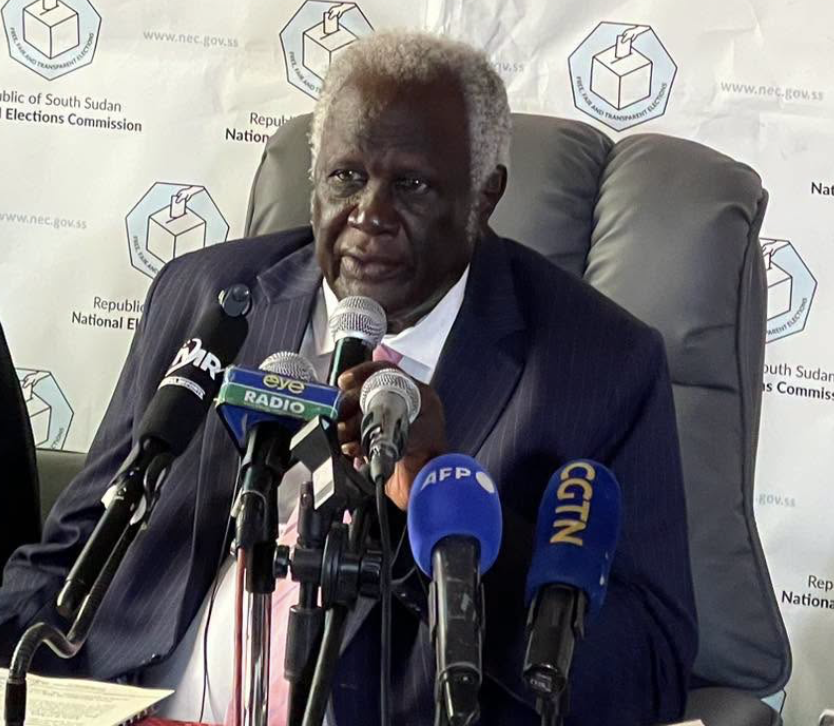
Speaking during the press conference at the Commission’s headquarters in Juba on Monday, NEC Chairperson Professor Abednego Akok Kacuol declared the election date and called on all stakeholders to support preparations for what would be South Sudan’s first elections since gaining independence in 2011.
“The election shall be conducted on 22 December 2026 throughout the Republic of South Sudan,” Professor Akok announced.
The election date comes against the backdrop of a fragile peace process and growing political uncertainty. South Sudan emerged from years of civil war that erupted in December 2013 following a political dispute between President Salva Kiir and opposition leader Dr. Riek Machar. The conflict, which claimed hundreds of thousands of lives and displaced millions, ended with the signing of the Revitalized Peace Agreement in 2018.
Under the peace agreement, elections were initially scheduled for 2022 before being postponed to December 2024 due to delays in implementing key provisions, including the drafting of a permanent constitution, security sector reforms, and the unification of forces. In September 2024, the Revitalized Transitional Government of National Unity extended the transitional period by another two years, pushing the elections to December 2026.
Professor Akok said the Commission has been working in accordance with the Revitalized Peace Agreement and the National Elections Act 2012, as amended in 2023, to prepare for the polls.
He cited Article 16 of the Elections Act, which requires the Commission to announce the election date at least six months before voting day and publish the notice through official government channels and the media.
“From 22 June 2026 to 22 December 2026 is exactly six months as required by law,” he explained.
Despite the announcement, concerns remain over the country’s political and security environment. The peace process has faced repeated setbacks, including delays in implementing critical reforms and growing tensions among signatories to the peace agreement.
Recent political developments have further heightened concerns after the detention of senior opposition figures and political activists, prompting calls from regional and international partners for respect for political freedoms, dialogue, and full implementation of the peace agreement.
Civil society organizations have also expressed concerns that restrictions on civic and political space could undermine confidence in the electoral process.
Professor Akok acknowledged that the Commission continues to face significant challenges and urged the government to address outstanding legal and logistical gaps.
He called for adequate funding, institutional support, and timely implementation of electoral requirements to ensure credible and peaceful elections.
The NEC chairperson also reminded citizens that voting remains the cornerstone of democratic governance and the primary means through which people exercise their sovereignty.
“As citizens, voting is your constitutional right and responsibility. It is the legitimate path through which leaders are elected in a democratic society,” he said.
He appealed to media organizations across the country to widely disseminate information about the election date and encourage public participation in the electoral process.
The announcement is expected to trigger a series of electoral activities, including voter education, constituency preparations, candidate registration, and continued efforts toward constitution-making as South Sudan moves closer to a historic vote that many hope will consolidate peace and democratic governance in the world’s youngest nation.