

The Standard Action Liaison Force (SALF) has unveiled findings from a nationwide electoral readiness assessment showing that while many South Sudanese are aware of the electoral process, significant gaps remain in voter education, institutional understanding, and election preparedness.
The assessment survey was conducted with support from the European Union in partnership with AHEAD Africa, E-HORN, and the South Sudan Network for Democracy and Elections (SSUNDE).
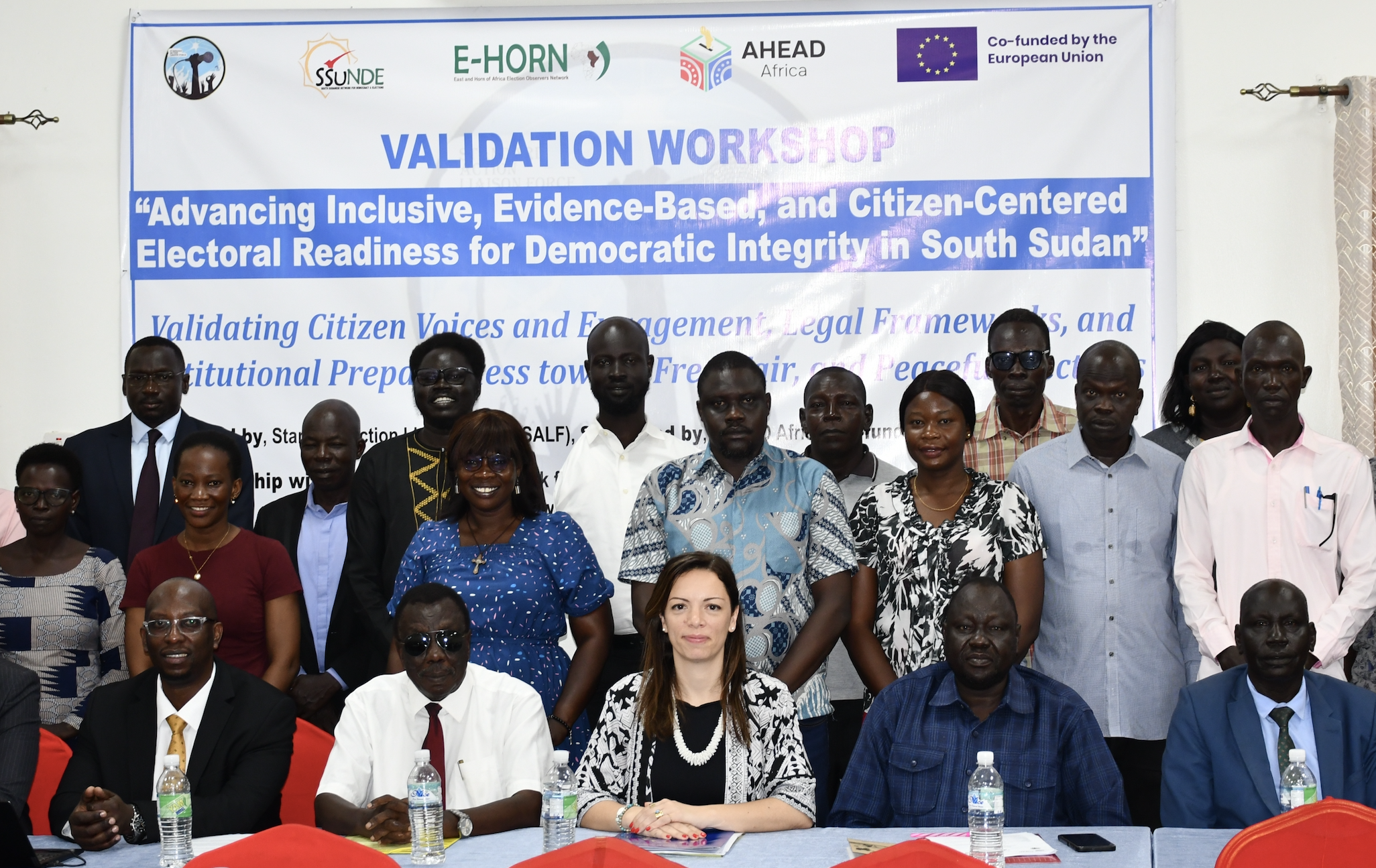
SALF presented the findings during a one-day validation workshop attended by key electoral stakeholders, including representatives from the National Elections Commission (NEC), civil society organizations, community leaders, peace monitors, faith-based groups, and persons with disabilities.
Speaking during the workshop, SALF Executive Director Lony Ruot Kok said the research found that 86 percent of the 903 respondents across seven assessment locations in South Sudan are aware of the electoral process.
However, he noted that knowledge of specific electoral procedures, voter registration processes, and the mandates of electoral institutions remains limited among the public.
The research covered six states including Central Equatoria, Western Bahr el Ghazal, Warrap, Jonglei, Western Equatoria, Upper Nile, as well as the Greater Pibor Administrative Area.
According to the findings, 86 percent of respondents are aware of the planned December 2026 elections, while 76 percent expressed willingness to participate in the electoral process.
The report noted that 70 percent of respondents consider elections important for democracy, accountability, and peaceful transfer of power.
Despite the positive public interest, the assessment identified major concerns over voter awareness, security, legal clarity, and operational readiness.
The Director of SSUNDE, James Okony Dau, said the promise of democratic transition under the Revitalized Peace Agreement remains alive, although fragile.
He noted that the planned 2026 elections are expected to mark the culmination of the transitional period and South Sudan’s first democratic exercise since independence.
However, he warned that major challenges continue to shape the electoral environment.
“The 2026 elections are expected to mark the culmination of the transitional period and the country’s first democratic exercise since independence. However, major challenges continue to shape the electoral process,” he said.
James cautioned that unresolved security, logistical, and financial challenges could make it difficult for elections to take place as planned this year.
Meanwhile, the European Union representative in South Sudan, Ms. Ines Narciso, emphasized that electoral readiness is critical to ensuring free and fair elections.
She highlighted the important role of civil society organizations in promoting voter awareness and educating citizens about their rights and responsibilities during the electoral process.
Ms. Narciso reaffirmed the European Union’s support for South Sudan’s democratic transition and encouraged the government to address logistical and security concerns that could undermine peaceful elections.
National Elections Commission Director General for Public Outreach, Barnaba Mayor Deng, commended civil society organizations for generating data that helps inform the commission about citizens’ views and concerns regarding elections.
He acknowledged that elections are a complex process requiring time, coordination, and contributions from multiple stakeholders.
Barnaba also appreciated the support provided by UNMISS, JICA, and other development partners assisting the electoral process.
He said the commission is technically prepared to conduct elections, but decisions regarding the type and timing of elections remain in the hands of political leaders.
According to Barnaba, the NEC has already developed civic education training manuals and is working with universities, faith-based institutions, women’s unions, and youth groups to carry out civic awareness campaigns in both urban and rural areas.
He further noted that legal gaps concerning elections under the peace agreement are currently being addressed by political leaders.
“I want to appeal to you that the politicians are moving toward amending the law that can give us a way forward for elections. The decision rests with the politicians. For us, we are a technical institution. They will decide which election to conduct because what we know is the general election,” he said.
Participants questioned the practicality of conducting the elections within the given timeframe and expressed concerns over the country’s preparedness, despite the government’s insistence that the elections must be held in December.
South Sudan is expected to hold general elections in December 2026 in line with the 2024 roadmap endorsed by the parties to the peace agreement.