

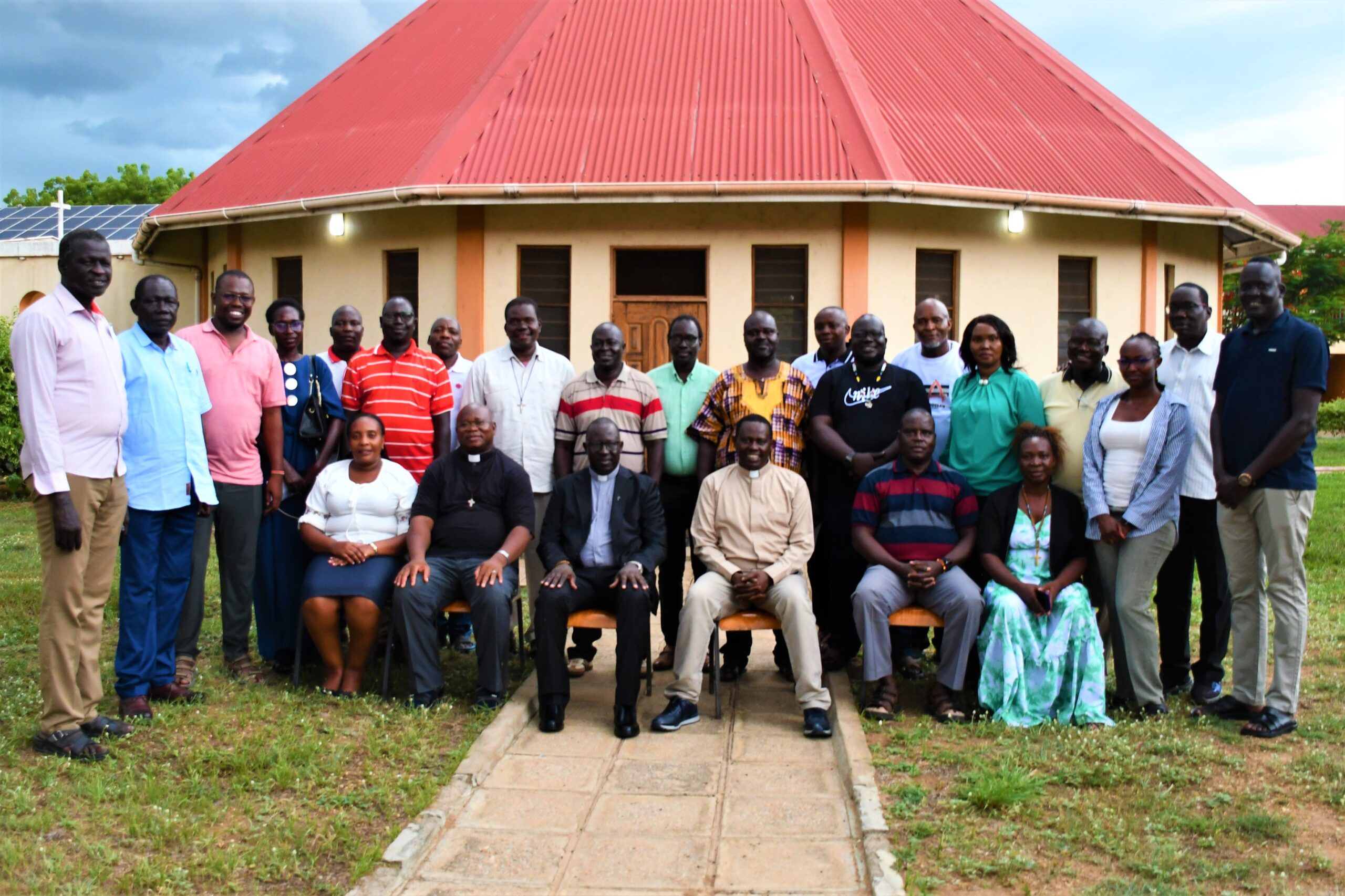
By Ginaba Lino|CRN_The Secretary General of the Sudan and South Sudan Catholic Bishops’ Conference, Rev. Fr. Martin Ochaya Lino, has urged Catholic diocesan leaders to translate knowledge gained from a week-long peacebuilding and advocacy workshop into concrete action, as a five-day training organized by the Association of Member Episcopal Conferences in Eastern Africa concluded at Kit Good Shepherd Peace Centre.
Speaking during the closing session, Fr. Ochaya described the workshop as “a meeting of hearts united by a common mission,” emphasizing that the gathering had gone beyond academic exchange to strengthen shared commitment among Church actors working across Sudan and South Sudan.
“This training has not simply been a gathering of minds, but a meeting of hearts united by a common mission to serve, to advocate, and to build lasting peace,” he said.
Over the course of the training, participants from diocesan Justice and Peace Commissions and Caritas offices explored key themes including peacebuilding, conflict resolution, mediation, negotiation, and advocacy. According to Fr. Ochaya, these tools are not optional but form part of the Church’s moral and pastoral responsibility in societies grappling with fragility and conflict.
He underscored the importance of advocacy as both a practical and moral instrument. “You have explored the power of advocacy not merely as a tool, but as a voice for the voiceless, a force for justice, and a pathway towards dignity for all,” he said.
Despite the progress made during the workshop, Fr. Ochaya acknowledged that communities across South Sudan continue to face significant challenges, including conflict, displacement, inequality, and humanitarian suffering. However, he stressed that Church institutions remain uniquely positioned to respond.
“Our presence in communities gives hope to the people, and our moral authority gives us confidence to serve as key agents of transformation,” he noted, adding that dioceses must actively engage in reconciliation, policy advocacy, and humanitarian response.
He called on participants to return to their respective dioceses with renewed commitment, urging them to promote unity where divisions persist and to defend human dignity wherever it is under threat. He also emphasized the need for practical interventions in areas affected by humanitarian crises.
Fr. Ochaya highlighted the importance of collaboration among dioceses, noting that shared learning and adaptation of best practices can significantly strengthen impact. “We borrow and adapt what we have learned to our context, recognizing that unity amplifies our impact,” he said.
The Secretary General also expressed gratitude to AMECEA for their continued support, singling out Rev. Fr. Paul Igweta and peacebuilding expert Bennett Okok for their longstanding engagement with the region. He noted that such partnerships have enabled diocesan staff to benefit from both in-country and regional capacity-building initiatives across Eastern Africa.
He stated that the SSSCBC is in the final stages of developing a comprehensive strategic plan aimed at strengthening institutional capacity across dioceses. The plan, expected to be launched in May, will guide diocesan programming and ensure alignment with the broader vision of the bishops’ conference.
In addition to the strategic plan, Fr. Ochaya pointed to ongoing efforts to strengthen governance structures through the development of key institutional policies, including safeguarding, finance, procurement, logistics, and human resource management frameworks. These, he said, are essential for accountability and for building trust with development partners.
“Without strong policies, it becomes difficult even to engage partners who want to understand our institutional capacity,” he explained.
He also encouraged participants to apply conflict resolution skills not only in large-scale national crises but within their daily work environments. “Conflict analysis and mediation are not only for national-level conflicts; they are tools for everyday life within our offices and communities,” he said.
In his remarks, Rev. Fr. Paul Mung’athia Igweta Coordinator of the Department of Integral Human Development at the Association of Member Episcopal Conferences in Eastern Africa (AMECEA) praised the participatory nature of the workshop and the dedication of facilitators, particularly Bennett Okok, whom he described as passionate and deeply committed to peacebuilding in South Sudan.
Fr. Igweta traced the origins of the initiative to a 2018 resolution by AMECEA bishops prioritizing peacebuilding in response to the region’s conflicts, particularly in the aftermath of South Sudan’s 2016 crisis. Since then, he said, the department has implemented a series of trainings across member countries, with South Sudan receiving sustained focus.
“We have done quite a number of trainings, especially from 2022, focusing on conflict analysis and peacebuilding, targeting grassroots structures within dioceses,” he said.
He added that the training forms part of broader preparations for peaceful and credible elections, equipping Church actors at diocesan and parish levels to promote civic responsibility and nonviolent participation.
Fr. Igweta also referenced ongoing regional collaboration efforts, including engagement with the Vatican and Catholic partners, aimed at sustaining peace initiatives and ensuring that key messages, such as those delivered during papal visits translate into long-term action.
He emphasized that AMECEA bishops are considering the establishment of a Commission for Peace and Solidarity to strengthen regional cooperation and allow bishops to better understand and respond to challenges faced in different countries.
As the workshop concluded, participants were encouraged to carry forward the spirit of the training and apply its lessons in their pastoral and social ministries.
“Peacebuilding is not a one-time event, but a continuous journey,” Fr. Ochaya reminded attendees. “Each one of us has a vital role to play.”
The five-day workshop brought together Justice and Peace Commissions, and Caritas Directors’ representatives from all eight Catholic dioceses in South Sudan, marking a significant step in strengthening the Church’s role in peacebuilding, advocacy, and social cohesion in the country.