

, with support from Norwegian People’s Aid (NPA), has convened a one-day Media Stakeholders Dialogue in Juba to address regulatory challenges and financial sustainability in the country’s media sector.)
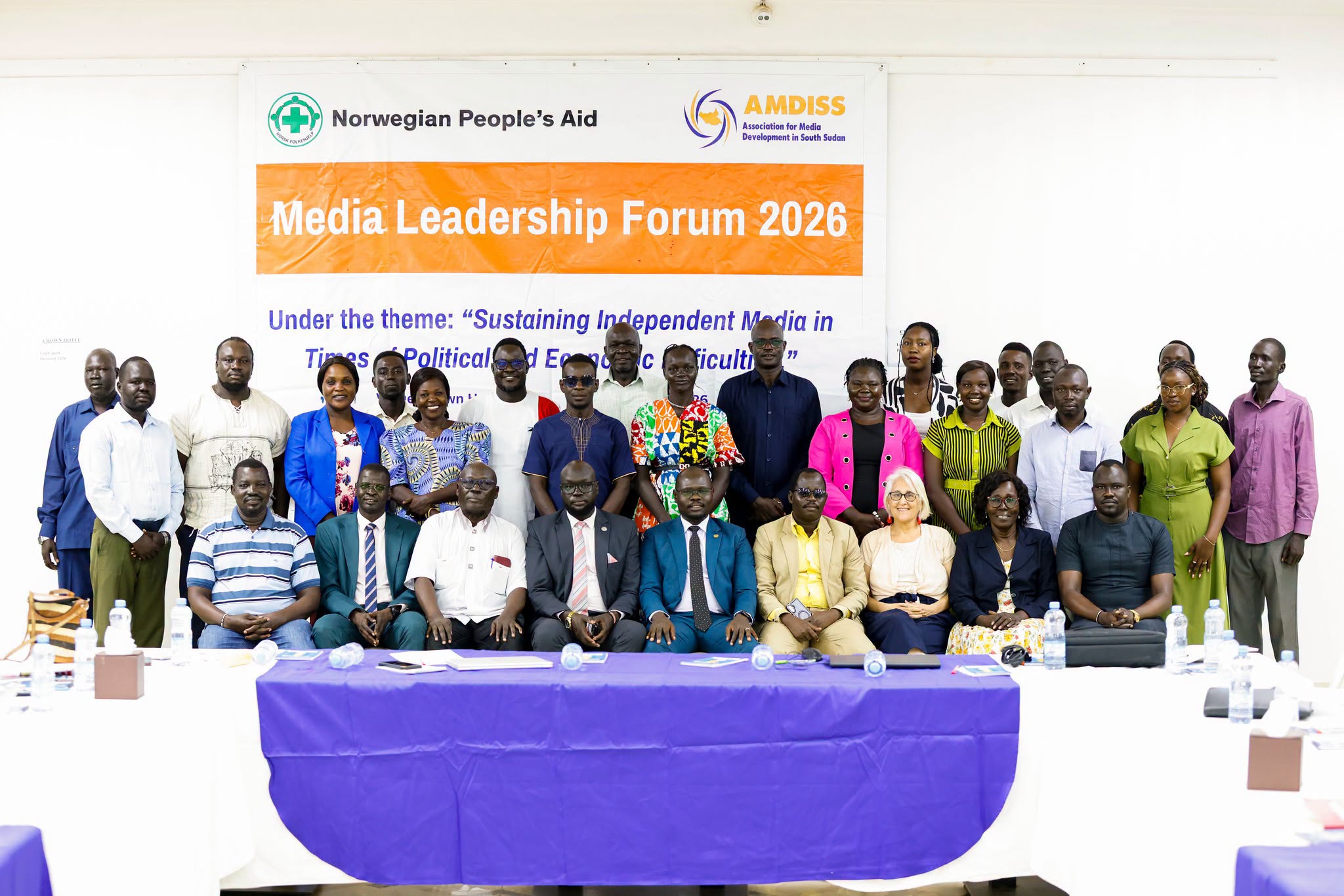
The Association for Media Development in South Sudan (AMDISS), with support from Norwegian People’s Aid (NPA), has convened a one-day Media Stakeholders Dialogue in Juba to address regulatory challenges and financial sustainability in the country’s media sector.
The dialogue, held on Tuesday in Juba, brought together representatives of media houses, the Ministry of Information, the Media Authority, the Information Commission and the National Communication Authority, among other stakeholders, to discuss challenges affecting media operations and explore possible solutions.
Speaking at the opening of the dialogue, AMDISS Director Ayaa Irene underscored the importance of constructive engagement among media institutions, government officials and regulatory bodies in addressing issues affecting the media sector.
Ayaa highlighted the critical role of regulatory institutions in protecting, promoting and developing the media sector. However, she stressed that media organizations should be involved in developing regulations that directly affect their operations.
“We know the regulatory system is a system that protects the media, promotes the media and develops the media. And as Media Houses and media institutions, it’s by law that we have to abide by those regulations. However, we also request that we should also be part of developing those regulations that are going to be implemented by us [media institutions],” she explained.
During the dialogue, AMDISS Board Chairperson Chris Marol presented a position paper titled “High Frequency Charges and Operational Licenses for Media Houses in South Sudan,” highlighting concerns about the financial burden of regulatory fees on media organizations.
The position paper also argues that high regulatory charges place additional financial pressure on media houses and threaten the sustainability of independent media organizations.
It calls for greater consideration of the financial realities facing media outlets and stronger engagement between regulators and media institutions in developing policies and determining fees that affect the sector.
Joyce Maker, NPA Senior Partnership Officer for Media Rights,emphasized that discussions on regulatory challenges should go beyond the cost of running media houses and focus on identifying practical solutions that promote both regulatory compliance and media sustainability.
“Discussions around regulatory challenges are not simply about the costs of running media Houses. This dialogue also presents us an opportunity together with the stakeholders to better understand each others’ responsibilities, the challenges that you all face and the expectations to explore practical solutions that we’ll be able to support both regulatory compliance as well as media sustainability,” she said.
Meanwhile, Undersecretary for Information Hon. Arok Dut Arok acknowledged the difficult operating environment facing media organizations in South Sudan.
He cited high operational costs, power shortages, limited advertising revenue, changing digital consumption patterns and declining donor funding among the challenges affecting media outlets, particularly community radio stations.
“Talking of media sustainability, a financially fragile press cannot remain genuinely independent. And across South Sudan, media houses face severe economic issues ranging from high operational costs, power shortages, limited advertising revenue on digital consumption and reduced donor funding. Many of our Community Radiostations and national outlets struggle daily just to keep the transmitters running,” he said.
Arok identified public-private partnerships and innovation as potential ways to strengthen the financial sustainability of media organizations. He encouraged media owners to diversify their business models and explore alternative revenue sources to reduce their dependence on traditional funding streams.
He also said the Ministry of Information, in collaboration with national partners, would continue examining regulatory fees, institutional support and measures to create a more favourable environment for the growth of local media.
The dialogue provided a platform for media representatives, government officials and regulatory institutions to exchange views on the challenges affecting the sector and discuss ways to improve cooperation.