


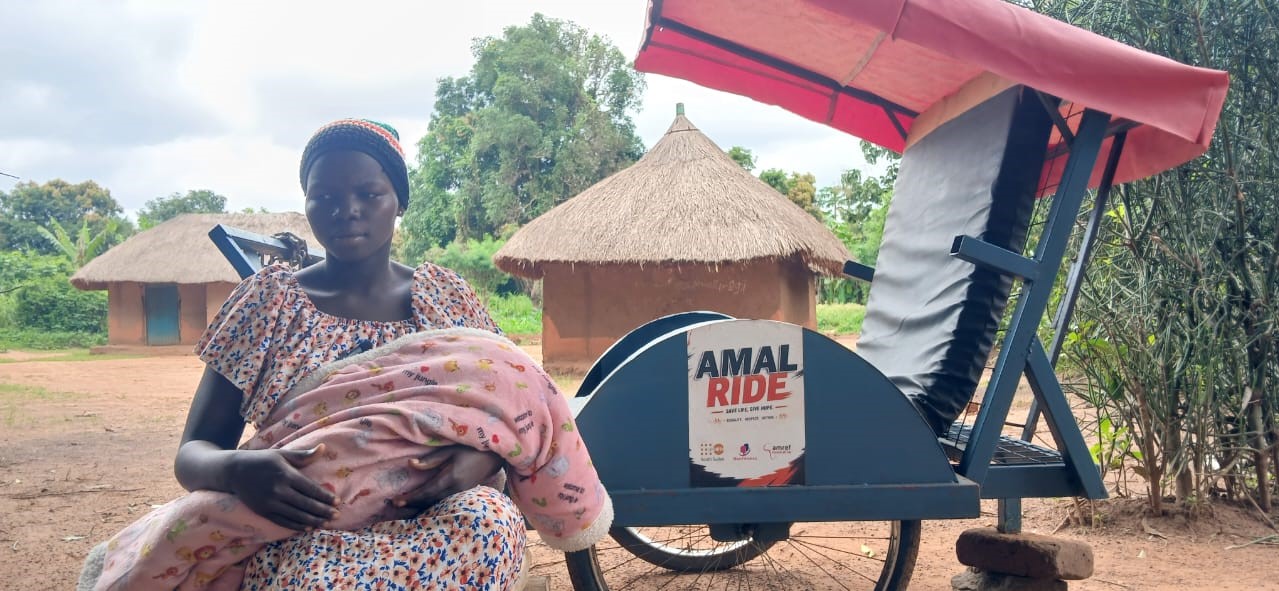
By Ginaba Lino
When labour pains began, Sheila Charles Mborikina knew she needed to reach a health facility. But the facility was about five kilometres away, and she had no reliable means of getting there.
Her husband had neither a motorcycle nor a bicycle. An ambulance was not readily available.
For Mborikina, the five kilometres from Bazungua Payam to a health facility in Yambio Town, Western Equatoria State, suddenly felt like an impossible distance.
“I would have delivered at home if the Amal Ride was not there,” she recalls.
Instead, a community-based transport service known as the Amal Ride came to her aid. Mborikina was transported to a health facility, where she safely delivered her baby.
Today, she holds her child in her arms, grateful that help arrived when she needed it most. “For us in Bazungua, the Amal Ride has become a lifeline,” she says.
According to the UNFPA South Sudan maternal health overview, pregnant women in South Sudan face extreme dangers and a near-total lack of emergency care, with a maternal mortality ratio estimated at 1,150 per 100,000 live births.
Only about 40 percent of health facilities in South Sudan are functional, and ongoing conflict has damaged or forced the abandonment of roughly 60 percent of facilities.
South Sudan’s national budget for the 2025/2026 fiscal year totals about 7 trillion South Sudanese Pounds (SSP), but direct government allocation to public health services remains critically low at around 1.3% to 1.4% of the overall national budget.
Civil society organizations and health sector officials have criticized the figures, noting that health funding remains far below the 15% target outlined in the 2001 Abuja Declaration.
Due to tight fiscal constraints, critical public health services and facility operations rely heavily on off-budget funding from international development partners and on projects such as the Health Sector Transformation Project (HSTP).
Across Bazungua Payam in Western Equatoria State, accessing healthcare can be challenging because of distance, road conditions, and cost.
The burden can be particularly heavy for pregnant women, people living with disabilities, older people, and patients whose conditions make walking or travelling on ordinary motorcycles difficult.
For years, families often had few options when a sick or vulnerable person needed urgent medical attention.
Victor Zakapu, the youth leader in Bazungua, remembers the situation before the bicycle ambulance arrived.
“Before this, we did not have anything like this to help patients who needed transportation to health facilities,” Zakapu says.
The bicycle ambulance, locally known as a Dagadaga, is designed to transport patients who cannot sit upright. It can be attached to a bicycle or motorcycle, allowing a patient to lie down during the journey.
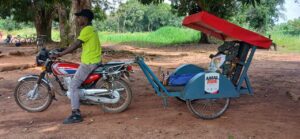
According to Zakapu, the service has already transported eight people, including a pregnant woman, a person living with a disability, and a man suffering from an illness affecting his hand and leg.
For 32-year-old Luka Godwill, the service became critical when both his legs became severely swollen, leaving him unable to stand or walk.
“I could not move on my feet. I had no way of standing up or going to the health facility,” Luka recalls.
For nearly two weeks, he says, he remained seriously ill without a reliable way of reaching medical care. Then members of the Amal Ride service found him.
“I was carried using the Amal Ride to the hospital. When I reached the hospital, I received treatment immediately,” he says.
For Luka, the bicycle ambulance was more than a means of transport. It was the bridge between being trapped at home and receiving medical attention.
“Whenever there is an emergency, it responds immediately and helps us reach the health facility,” he says.
A journey that still has its challenges
Getting patients to care is not always easy. Rough roads, hills, and difficult terrain can slow bicycle journeys. Travelling by motorcycle can also be uncomfortable for people experiencing severe pain or physical weakness.
But Luka says the Amal Ride gave him a more comfortable way to travel.
“With Amal Ride, you feel comfortable. It is almost like lying on your bed at home. You do not feel the same pain while being transported,” he says.
He believes the service could become even more effective with motorbike support, particularly during emergencies. The need is especially evident for pregnant women.
Sheila recalls cases in which women have had to walk long distances, give birth at home, or even deliver along the road because their families could not afford transportation to a health facility.
“Before Amal Ride came to our community, life was very difficult for us,” she says.
The Amal Ride is implemented by Men 4 Women, with support from UNFPA through Amref Health Africa, to address transportation barriers to healthcare in Bazungua.
Data Gordon of Men 4 Women says the initiative is intended to reduce delays in reaching healthcare, particularly during emergencies.
“For us at Men 4 Women, this initiative is about preventing avoidable delays in accessing healthcare. When a woman is in labour or someone is facing a medical emergency, every minute matters. Reliable transport can help ensure that distance, poverty or lack of other means of transport does not prevent people from reaching care in time,” Gordon says.
More than a bicycle
Community leaders say the service has shown what a relatively simple intervention can mean for people living far from health facilities. But they also say more support is needed.
Zakapu is calling on donors and partners to continue supporting Men 4 Women and to help provide a motorcycle that could strengthen the service.
“We request the donors to continue helping Men 4 Women so that they can help us,” he says.
He also wants similar transportation support extended to other communities and bomas across Yambio County.
For families in Bazungua, the challenge is not always whether healthcare exists. Sometimes, the question is whether they can reach it in time.
For Mborikina, the trip ended at a health facility with the safe arrival of her child, thanks to timely assistance when it was most needed. In Bazungua, the Amal Ride can make the difference between danger and safety.
For Luka, it meant reaching a hospital after his illness left him unable to walk; it was the difference between being stranded and receiving timely treatment. The Amal Ride is more than transport because it provides access to care.
Although the bicycle ambulance is a simple piece of equipment, in Bazungua its value is measured by the journeys it makes and by the patients who reach medical care when they need it most. Its true worth is reflected in the lives it helps to save.
For Mborikina, the meaning is both deep and lasting. The Amal Ride did more than take her to a healthcare facility; it helped her get safely to care and to the moment when her baby was born.
“The Amal Ride did not simply transport me to a health facility,” she says. “It helped me reach care safely when I needed it most.”