
 South Sudan, in partnership with Oxfam and the Humanitarian System Transformation through Local Humanitarian Leadership (HST-LHL) initiative, has held a one-day quarterly localization roundtable with journalists and media houses in Juba to strengthen media partnerships and promote locally led humanitarian action.)
By: Ginaba Lino
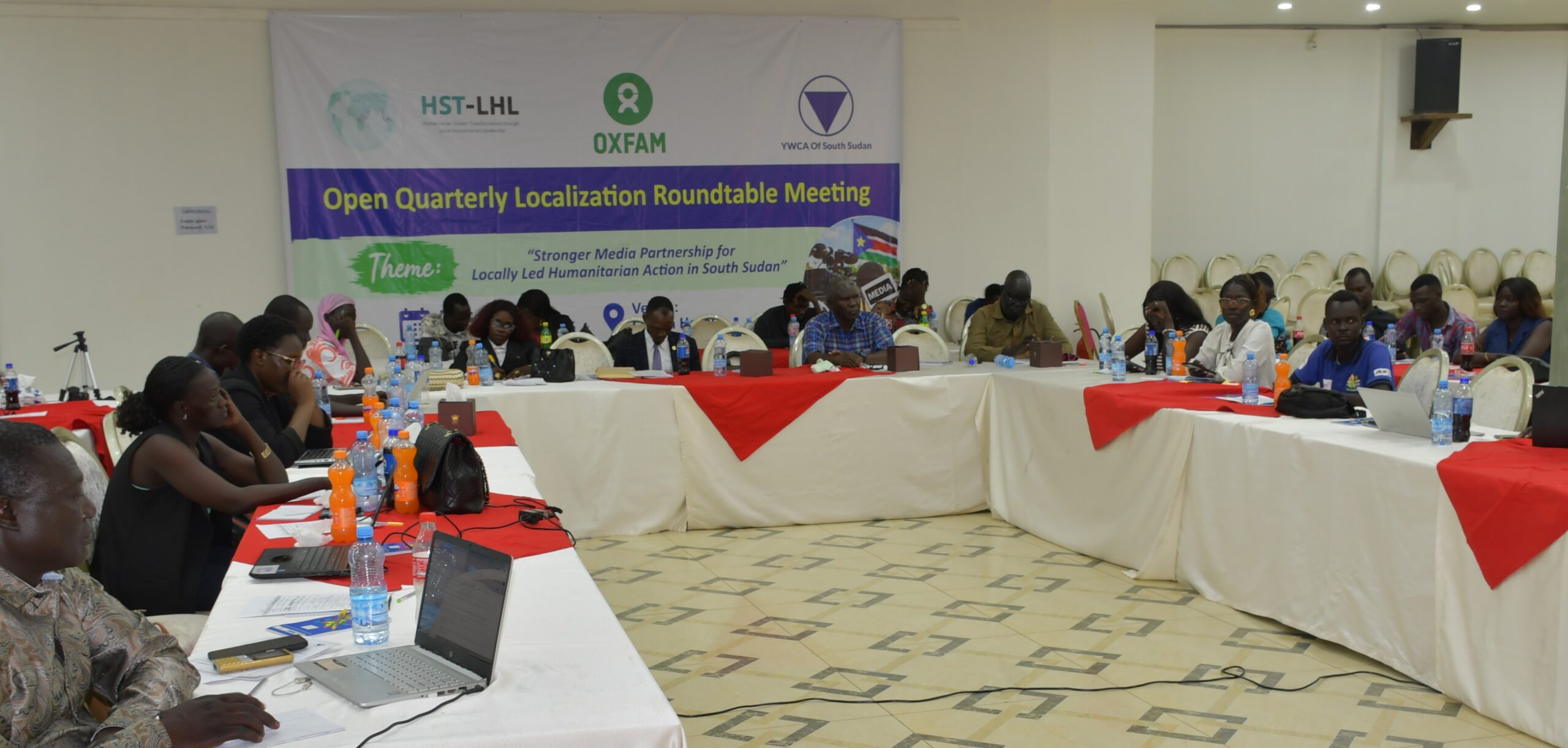
The Young Women’s Christian Association (YWCA) South Sudan, in partnership with Oxfam and the Humanitarian System Transformation through Local Humanitarian Leadership (HST-LHL) initiative, has held a one-day quarterly localization roundtable with journalists and media houses in Juba to strengthen media partnerships and promote locally led humanitarian action.
The roundtable, organized under the theme “Stronger Media Partnership for Locally Led Humanitarian Action in South Sudan,” is part of a three-year project funded by the Ministry of Foreign Affairs of the Netherlands.
The meeting brought together journalists from various media houses, representatives of women-led organizations, civil society groups and other stakeholders to discuss the media’s role in amplifying local voices and promoting community-driven humanitarian solutions.
Discussions focused on advancing the localization agenda, building practical partnerships between media organizations and local humanitarian actors, and ensuring that communities affected by humanitarian crises have a greater voice in decisions that affect their lives.
Speaking during the opening session, YWCA South Sudan Managing Director Namisio Joy Bage emphasized the importance of placing local communities, particularly women and girls, at the center of humanitarian decision-making and leadership.
“For us, localization is about more than shifting resources. It’s about ensuring that local actors and communities have meaningful voices in decision-making, leadership, implementation and accountability,” Bage said.
She stressed that women-led organizations have an important role in transforming humanitarian responses by ensuring that affected communities are recognized not merely as recipients of assistance but as active participants in developing sustainable solutions.
“As a women-led organization, YWCA South Sudan strongly believes that women, girls and communities must be at the centre of all the processes, not simply as beneficiaries, but as leaders, partners and problem solvers with valuable knowledge and solutions,” she added.
Bage also highlighted the media’s responsibility to promote balanced and responsible reporting that recognizes the contributions, resilience and leadership of South Sudanese communities.
She urged journalists to move beyond narratives that portray communities solely through their vulnerabilities and instead highlight locally developed solutions and the leadership of people responding to humanitarian challenges.
“The media has an important role to play in shaping this narrative. We encourage responsible storytelling that goes beyond communities’ vulnerability and instead recognizes the resilience, leadership, contributions and solutions of the people of South Sudan,” she said.
The YWCA Managing Director encouraged participants to engage in open and practical discussions aimed at identifying concrete ways media organizations can support the localization agenda and strengthen collaboration with local humanitarian actors.
The roundtable featured panel discussions exploring the media’s role in advancing humanitarian localization, strengthening partnerships between journalists and local organizations, and amplifying community-driven responses to humanitarian challenges.
The three-year initiative, funded by the Netherlands’ Ministry of Foreign Affairs, seeks to support efforts to strengthen local humanitarian leadership and promote greater participation by local actors in humanitarian responses in South Sudan.
The meeting provided a platform for journalists, women-led organizations, and civil society representatives to explore opportunities for collaboration and promote greater visibility of locally led humanitarian initiatives.