

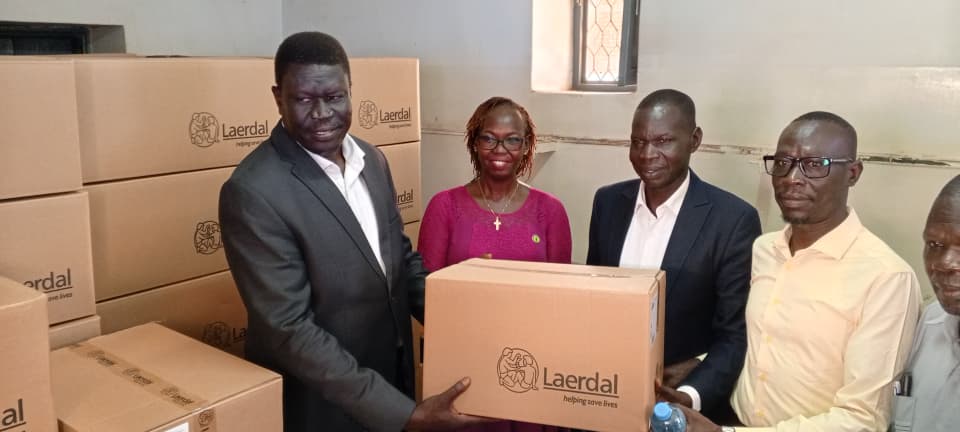
 has officially received maternal and newborn health training simulators donated under the TRUST Project to strengthen practical skills among healthcare workers.)
By Ginaba Lino
The Association of Gynecologists and Obstetricians of South Sudan (AGOSS) has officially received maternal and newborn health training simulators donated under the TRUST Project to strengthen practical skills among healthcare workers.
The equipment was provided through a partnership between Laerdal Global Health and the Canadian Association of Midwives (CAM), with support facilitated through international professional health partners. The simulators are expected to give obstetricians, midwives, nurses and other clinicians hands-on experience in managing maternal and newborn health emergencies before they provide care to patients.
AGOSS President Dr. Idyoro Ojukwu said the equipment is particularly important for South Sudan, which continues to face a high maternal mortality burden and needs stronger practical training for healthcare providers.
“We have one of the highest maternal mortality rates in the world, as a country, and we think we need to improve on our training.”
Dr. Ojukwu said the simulators would help health workers repeatedly practice emergency obstetric and newborn care skills in a controlled environment. She explained that the initiative had taken about three years to complete, including efforts to secure tax exemption for the donated equipment.
She emphasized that AGOSS would work with partners to ensure the simulators are distributed and used effectively to strengthen the capacity of healthcare providers.
Director General of Juba Teaching Hospital, Dr. Anthony Lopai Simon, stated the simulators will support health workers to build confidence and competence before handling real patients.
“Before they go to touch patients properly, they should be taught using this simulator so that they go there adequately and confidently knowing what they are going to do.”
Dr. Simon said the equipment had already been brought to Juba Teaching Hospital and safely stored while awaiting the official handover. He pledged that the simulators would be used for training rather than remain in storage. He said proper use of the equipment would help healthcare workers improve their practical skills and ultimately benefit patients receiving maternal and newborn services at the hospital.
Representing the Minister of Health, Director General Dr. Michael Mading said the Ministry views professional associations such as AGOSS as important technical partners in improving healthcare services.
Dr. Mading said the equipment will help in strengthening the continuous professional development and hands-on training for healthcare workers, particularly those providing maternal, newborn and adolescent health services. He said the simulators had arrived as the Ministry updates guidelines on obstetric care and implements its reproductive, maternal, newborn, child and adolescent health strategies.
He added that the five-year TRUST Project, supported by the Canadian government in South Sudan and Malawi, would complement existing training institutions and specialized programmes.
The health authorities and AGOSS said they would work with partners to ensure the simulators are effectively integrated into practical training and contribute to improved quality of care for mothers and newborns.