
 has defended the legitimacy of its newly elected leadership, rejecting claims by a rival faction that questioned the authority of the church's 35th General Assembly and the leaders it elected.)
By Ginaba Lino
The Presbyterian Church of South Sudan (PCOSS) has defended the legitimacy of its newly elected leadership, rejecting claims by a rival faction that questioned the authority of the church’s 35th General Assembly and the leaders it elected.
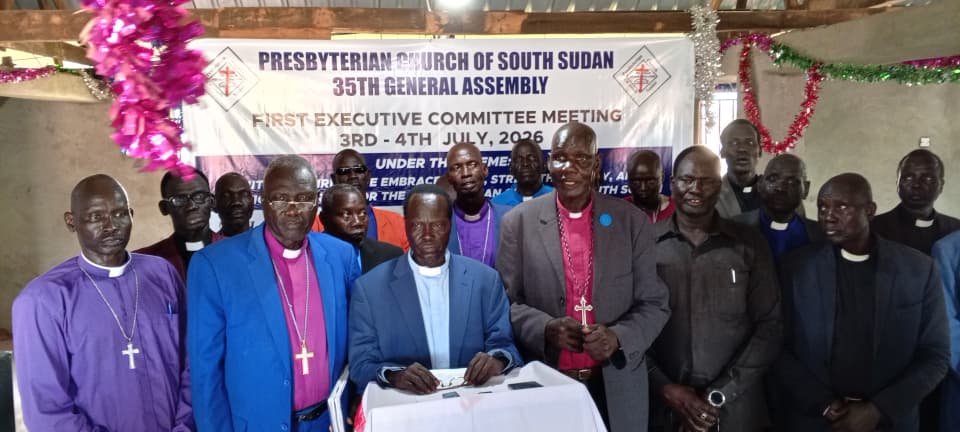
Speaking during the press conference issued in Juba on July 3, the (PCOSS) church leaders said the 35th General Assembly was convened in full compliance with the church constitution and remains the highest governing authority of the Presbyterian Church.
The clarification followed a statement by Reverend James Makue Chol on July 2, in which he challenged the legitimacy of the Assembly and its leadership.
Rev. Santino Odong Othol, Vice Moderator of the 35th General Assembly, who read the statement said, the dispute dates back to divisions that emerged after the 2020 General Assembly, when a group led by Rev. Makue Chol adopted the name Presbyterian Church of South Sudan and Sudan, while the majority continued under the constitutional name Presbyterian Church of South Sudan.
Rev. Othol stressed that several reconciliation efforts involving church partners, the Office of the suspended First Vice President Dr. Riak Machar, and the All Africa Conference of Churches (AACC) had failed to reunify the two groups.
“The issue before us is not a conflict between individuals or groups, but a matter of obedience to the Constitution,” the statement read.
The church maintained that the 35th General Assembly was duly convened following the completion of the previous leadership’s constitutional term and that the leaders elected during the assembly are the only constitutionally recognized leaders of the denomination.
Responding to questions from journalists, the Moderator of the 35th General Assembly, Rt. Rev. Dr. James Ninrew, said the Presbyterian Church follows a democratic governance system in which authority is exercised through presbyteries and the General Assembly.
“Presbyterian governance is a church governed democratically, and the people who install leaders are the members of the congregation through their presbyteries,” he said.
Rt. Rev. Ninrew also stressed that church leaders serve a four-year term and can only be re-elected through the General Assembly.
“The General Assembly gives the mandate. The Executive Committee cannot extend its own tenure because that is not provided for in the Constitution,” he said.
Church leaders called for reconciliation, constitutional order, and Christian unity while urging South Sudan’s leaders to uphold peace and fully implement the 2018 Revitalized Peace Agreement.