


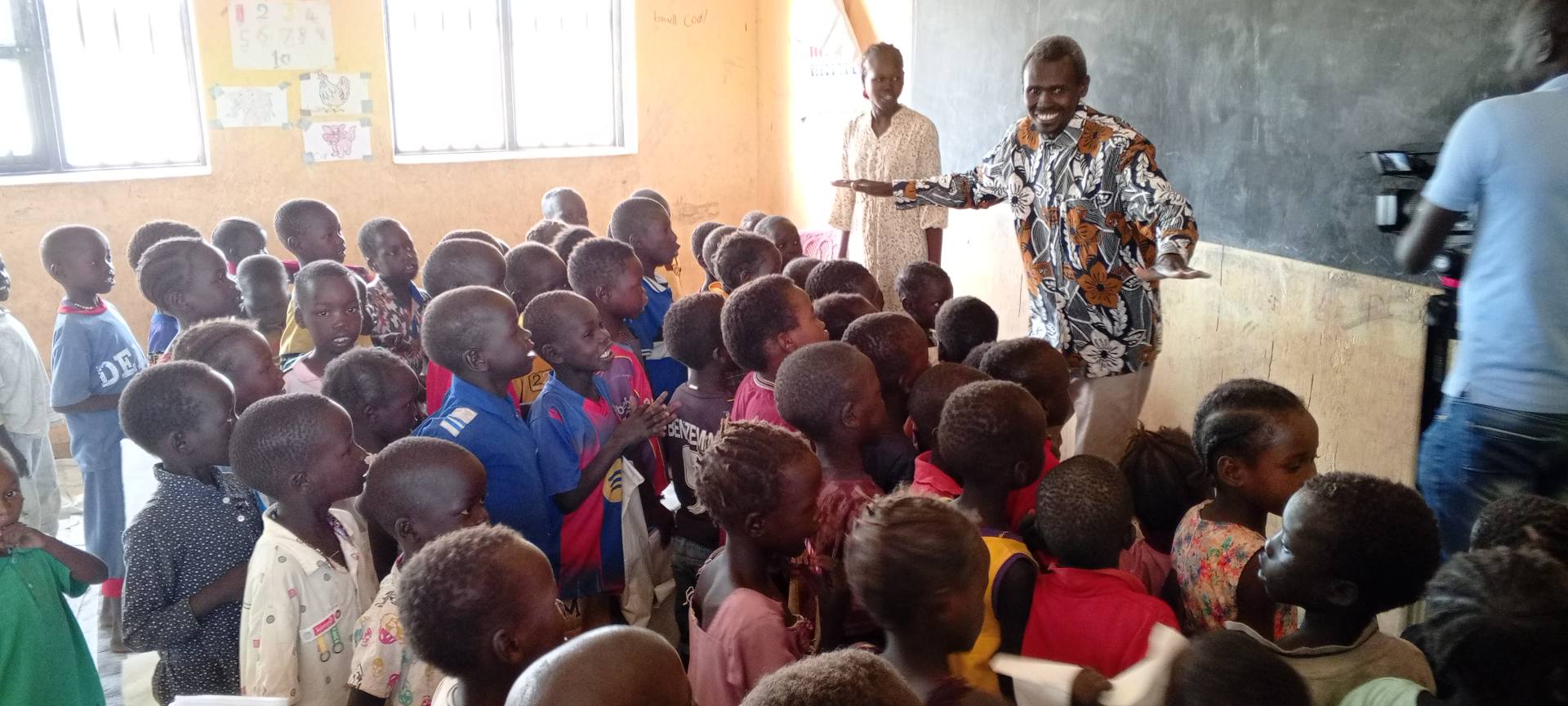
CRN|Ginaba Lino|After more than ten years of silence, the voices of children learning have once again filled Abukadra Primary School, bringing renewed hope to families in Wengayen Boma, Renk North County.
The school, which had been closed for over a decade due to instability and displacement, officially reopened in August 2025. This milestone was made possible through the support of UNICEF, with funding from European Civil Protection and Humanitarian Aid Operations (ECHO) and implementation by Community in Need Aid (CINA).
Today, the school serves more than 600 pupils—many stepping into a classroom for the very first time.
For children whose education was interrupted for years, the reopening marks a new beginning.
“I am happy to be in school again,” one pupil shared. “Before, we stayed at home without learning. Now I want to become a teacher.”
Nyacheng Kuoth Michael, now in Primary Seven after missing several years of schooling, said the school’s reopening has restored her sense of hope. She expressed appreciation to UNICEF, ECHO, and CINA for supporting both returnee and host communities.
Despite this progress, significant challenges remain. Limited temporary learning spaces have led to severe overcrowding, with some classrooms accommodating more than 200 pupils—making effective teaching difficult.
“There is a big difference now compared to before,” said Head Teacher Jacob Biel Nyak. “But we still lack enough classrooms, desks, and teaching materials. The children are eager to learn, but the environment is not yet adequate.”
Parents and community leaders say the school’s reopening has brought much-needed relief, particularly for families returning after years of displacement. Many had feared their children would grow up without access to education.
“This school is very important for us,” said a Parent-Teacher Association member. “Our children now have a future. We are grateful for the support, but we still need more classrooms and access to clean water.”
According to Ayen Joseph Maker, Project Manager at CINA, the organization is implementing education-in-emergencies programmes in Abukadrak with support from UNICEF and funding from ECHO. The initiative focuses on teacher training, provision of learning materials, and strengthening community engagement.
Teachers are being trained in emergency education approaches as well as mental health and psychosocial support to assist children affected by displacement. The programme has also introduced child help desks offering counselling services, while Parent-Teacher Associations are receiving training in school management, community dialogue, and resource mobilization.
CINA has provided essential scholastic materials—including textbooks, chalk, and dignity kits for girls—though resources remain limited. School enrolment has risen rapidly, from about 231 learners at reopening to over 700 today.
Most teachers are volunteers from the returnee community, with only two of the 16 currently on the government payroll. Limited funding continues to affect teacher incentives and overall support, even as demand for education continues to grow.
Renk County Education Director Aleir Kur commended UNICEF and its partners for their continued efforts, noting that the education system is under increasing pressure following the conflict in neighboring Sudan, which has led to a large influx of refugees and returnees.
He added that nearly 90 percent of newly arrived children have been integrated into schools through joint efforts between the government and humanitarian partners. However, he called for increased donor support to address shortages in learning materials and reduce pressure on the overstretched system.
Despite ongoing challenges, the reopening of Abukadra Primary School stands as a powerful symbol of resilience. Where classrooms once stood empty, children are learning again—rebuilding not only their education, but also their future.