


By Ginaba Lino
For more than a decade, South Sudan’s conflict has stripped thousands of children of their most basic rights: education, protection, health and the security of family life. Many have grown up too quickly, carrying rifles instead of schoolbooks, learning survival before literacy.
In Western Equatoria, the war’s imprint remains visible. Schools once filled with lessons stand abandoned, blackboards coated in dust. Health centres meant for mothers and children lie empty. For many young people, the promise of peace and education has faded into abstraction.
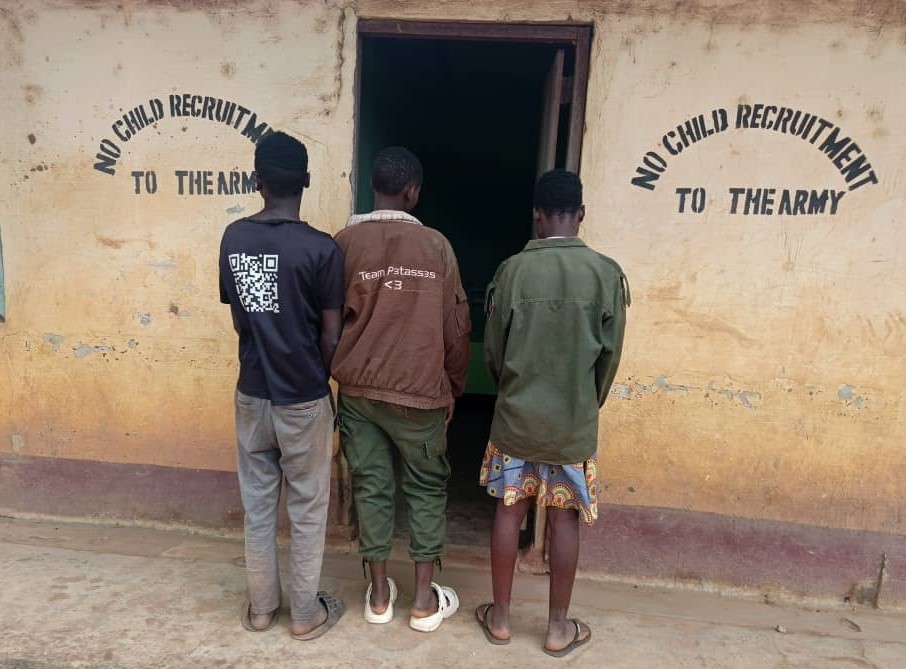
One of them is a 17-year-old boy from Rii-Menze, among 22 children released from armed groups late last year. For his safety, his name is withheld. He traces the loss of his childhood to 2018, when he sought refuge in a church.
“We were arrested inside the Catholic church,” he recalls. “The soldiers told us to escort them to collect weapons from Congo. They promised we would come back. But when we reached their base, they told us we were not going home again.”
Instead, he was absorbed into the machinery of war. “From then, we were made to carry firewood, wash clothes and offload supplies.”
He spent nearly seven years in the bush, often hungry and constantly afraid. “Sometimes we stayed three days without eating unless we were robbed along the road,” he says. “Once, we were attacked and ran for seven days without food.”
Back in Rii-Menze, rebuilding life has been slow. “Before UNMISS took us to Yambio, I wasn’t comfortable,” he says. “My mind was still in the bush.” Counseling helped. “Now I feel more normal and happier.” Still, the losses are stark. “Since I came back, I haven’t seen my father. I live with my aunt. I feel like I am nothing because the conflict destroyed my education and my future.”
Across Western Equatoria, parents tell similar stories. Jacob Serazio, a father of nine, remembers when armed men took his 12-year-old son in 2017.
“When they took my son, I lost hope,” he says. “When he came back, he was not the same. He gets angry easily and sometimes acts as if he’s still in the bush.” He pauses. “But I thank God he is alive.”
Support from humanitarian organisations has helped his son begin to recover. “After counseling, he listens and helps around the house,” Jacob says. “My prayer is for him to go back to school. He was taken by force; I never wanted him to join.”
For many children who return from the bush, reintegration is uneven. Some sit silently in classrooms, unable to concentrate. Others are rejected, stigmatised by peers, and labelled “soldiers”. The conflict has blurred the boundary between innocence and survival.
Moses Miamangawai Luzino, a Payam youth leader in Bangasu, Yambio County, says the war has fractured communities and particularly children. Many were separated from caregivers; others were abducted and taken for military training. Some escaped and returned home, but few returned unchanged.
“I have witnessed things I never thought I would see in my lifetime,” he says. “Children returning from the armed groups are struggling psychologically with what they have had to endure and witness in the bush. Even when they are with their families, they struggle to fit in.”
Some behaviours linger. “You see them carrying sticks shaped like guns, hiding by the roadside pretending to attack people,” he says. “They are not psychologically stable. Some have started using harmful drugs they had never used before.”
He adds that children were sometimes lured by false impressions of a good life in armed groups. “They thought being in the bush meant living well. When they saw fighters with money, they believed that was a good life.”
The youth leader, said, community leaders face practical from the armed groups when trying to get the children back.
Yet he remains cautiously hopeful. “Give them pens instead of guns,” he says. “If security sector actors and communities work together, these children can become the future of Western Equatoria, these children can become the future of Western Equatoria.”
The conflict has destroyed not only childhood but also weakened the social fabric itself. In Tambura, Nagero and Mundri East, insecurity continues to displace families and empty classrooms. “Some children have lost both parents,” says John Zeboruna Gassi, director-general for gender, child and social welfare in Western Equatoria. “They grow up without guidance, care or safety.”
Government and partners provide counseling, health checks and psychosocial support, he says, but demand far exceeds available capacity. “When children come to our care centres, we try to restore their confidence. But insecurity and lack of understanding of child protection laws make our work harder.”
Many communities, he adds, remain unfamiliar with the South Sudan Child Act. “The laws are there to help,” he says. “But they are not always accepted or followed. That’s why awareness matters.”
The war’s damage extends well beyond those who carried weapons. It has stolen an entire generation’s chance to grow up in peace. Hellen Erimunio Abiambo, acting coordinator of the Disarmament, Demobilisation and Reintegration (DDR) Commission says many returning children are traumatised and are lagging years behind in school.
“Some have not seen a classroom in years,” she says. “Others lost their parents completely. Their right to education and to childhood itself has been taken away.”
Last year, the DDR Commission and its partners helped release 28 children from armed groups in Western Equatoria, some as young as 13 years old. Many are now enrolled in schools or vocational centres. At a transit centre in Yambio, supported by UNICEF, children received food, medical care and counselling.
“When we gave them notebooks and pencils, some broke down in tears,” recalls Denis Bambura, a child-protection officer with UNMISS. “It symbolized that they were becoming children again.”
Recovery is rarely linear. Kubako Johnson Mosa, a senior social worker at Save Lives Initiative South Sudan, says trauma runs deep. “Many have nightmares and anxiety. Some are rejected by their own communities. We remind people these children are victims of armed conflict, not criminals.”
Education, he says, remains the strongest antidote. “When a child returns to school, you see the change. They begin to dream again.”
Despite everything, resilience persists. Some children formerly recruited and used by armed groups now speak publicly against recruitment and use, urging others to choose education over arms. Their progress is fragile, but meaningful.
In Western Equatoria, where conflict once silenced childhood, those dreams are beginning to stir again, tentative, vulnerable, but unbroken.
This story is produced with support from Journalists for Human Rights (JHR) And Dallaire Institute for Children, Peace and Security