

By Ginaba Lino
The Governor of Upper Nile State, Lt. Gen. James Koang Chuol, has called on the Catholic Church of Germany through the Misereor Delegation to South Sudan to continue praying for South Sudan and strengthen its support for peace, reconciliation and humanitarian assistance, particularly in conflict-affected areas of Upper Nile State.
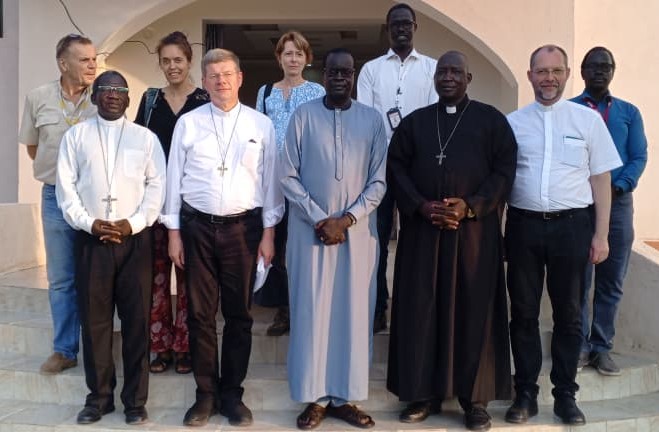
Governor Koang appealed during a courtesy visit by a delegation from Germany led by Archbishop Stefan Burger of Freiburg and Fr. Dr. Andreas Frick, Director of Misereor, the German Catholic Bishops’ Organization for Development Cooperation.
The delegation also included Katherina Goette, Misereor Desk Officer for South Sudan; Uwe Bergmeier, Head of Dialogue and Partnership Services; and Ita Reilly, Misereor Translator.
The governor welcomed the delegation, saying the Misereor visit was an important opportunity to draw international attention to the humanitarian and security challenges facing communities in Upper Nile.
“It is good that our situation is known to the people of the Church and humanitarian organizations. We need help—a great deal of help,” Governor Koang said.
He emphasized that the challenges facing South Sudan cannot be addressed by the government alone, calling for stronger cooperation with the international community and the Church.
“You cannot work alone. You have to work with different people globally. The churches are always leaders, and when there is a crisis in the country, the Church appears,” he said.
Governor Koang said Upper Nile continues to face serious challenges, including insecurity and displacement, particularly in parts of the eastern areas of the state.
“We have problems in our country. We need help. Our situation needs humanitarian assistance. We need to be assisted because we see that we cannot do it alone,” he said.
Meanwhile, the Director of Misereor Fr. Dr. Andreas Frick, explained that Misereor was established in Germany after the Second World War, when the German Catholic bishops recognized the need to support people facing poverty, conflict and suffering around the world.
Frick said Misereor currently works with partners in 83 countries across the Global South, including South Sudan.
“Our task is to find out where the needs are and what our possibilities are,” Frick said, emphasizing that Misereor works through local partners rather than imposing solutions from outside.
He said the organization seeks to understand the realities facing communities and identify how it can contribute to social development and the wellbeing of people.
Frick, who was making his first visit to South Sudan, said he had been deeply impressed by the hospitality he had received and the young people he encountered, describing them as “full of hope.”
Archbishop Stefan Burger thanked the people of Upper Nile and Bishop Stephen Nyodho Ador Majwok of the Catholic Diocese of Malakal for the warm welcome extended to the delegation.
Emphasizing the relationship between the Church and the state, Archbishop Burger said the Church does not seek to take on the role of government but must retain the freedom to proclaim its faith and serve communities.
“The Church cannot do politics, and it is also not the task of the Church. But the Church also needs its liberty and freedom to proclaim the faith,” he said.
He stressed that living out the Christian faith also requires social engagement and solidarity with people in need.
“Because of the message of Jesus, we should be a community of solidarity. And this is not only limited to Germany, but it is valid for the whole world,” he said.
Archbishop Burger said the Church in Germany, including Misereor, remains committed to supporting people in South Sudan who have suffered from years of conflict and humanitarian crises.
“I hope that the politicians also see that the Church is doing all this good work, and that there is a collaboration between the state and the Church to establish a good future for South Sudan,” he said.
The visit comes as communities in Upper Nile continue to face the consequences of prolonged conflict, displacement and humanitarian challenges, while Church institutions and humanitarian partners remain engaged in efforts to promote peace, reconciliation and support for vulnerable populations.