

By Ginaba Lino
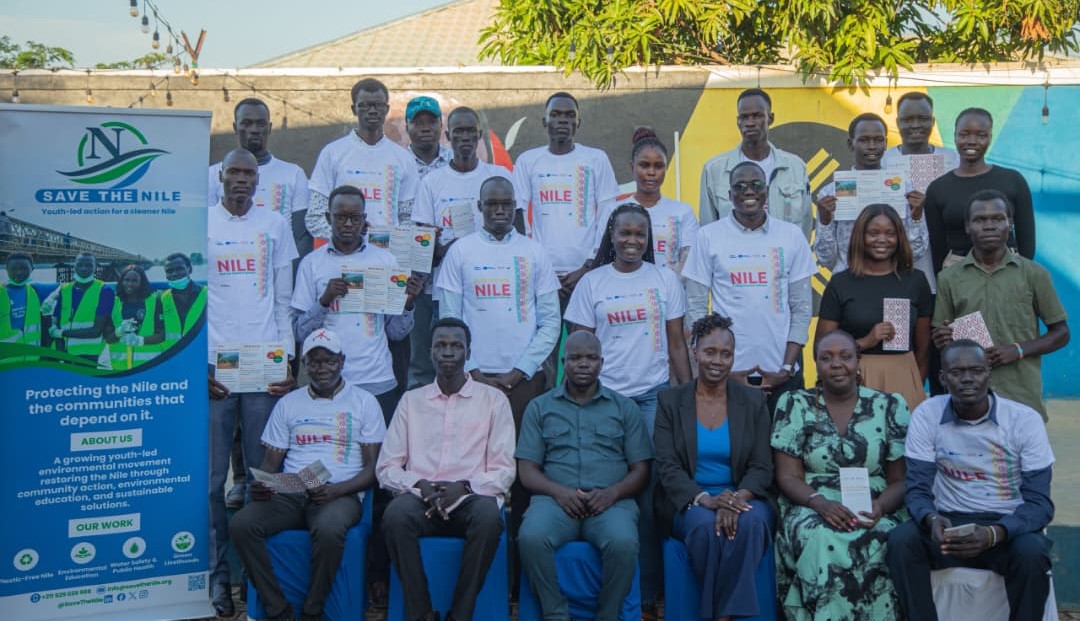
Save the Nile has launched a three-month Plastic-Free Nile project worth EUR 5,000 to reduce plastic pollution through environmental education, community clean-up campaigns, public awareness and policy advocacy.
The youth-led initiative, supported under the AU-EU Youth Voices Lab “Power of the Collective,” brings together young people, schools, government institutions, civil society organizations, media and local communities to address plastic pollution.
Speaking during the launch, Save the Nile founder Makur Majeng said the organization started in January 2025 as an idea before growing into a youth-led environmental initiative.
“Save the Nile started last year in January 2025 as an idea, and through collective action, we have managed to organize some of the cleanup events and also initiate discussions on social media and through radio,” Majeng said.
He recalled that during World Environment Day 2025, Save the Nile worked with the Environmental Club at the University of Juba to organize a major clean-up campaign involving more than 120 students, government officials, volunteers, NGO leaders and private-sector representatives.
Majeng said the new project will focus on three main approaches: environmental education in high schools, community action through regular clean-ups and engagement with government institutions to strengthen environmental action and waste management.
He said the project plans to mobilize about 100 young people, conduct clean-up activities in Juba, provide environmental education in three high schools and organize five school workshops.
“We believe that together we can make a difference, and plastic pollution cannot be solved by one organization.”
He called for cooperation among government institutions, youth groups, schools, fishing communities, media and civil society organizations to protect the Nile.
Meanwhile, the Director General for Culture, Youth and Sports in Central Equatoria State, Emmanuel Ladu Kode, commended Save the Nile and described the project as an important youth-led initiative.
“This is a youth-led initiative, and it is important for the concerned ministry to come and attend this important event,” Ladu said.
He urged citizens to take responsibility for keeping their environment clean, saying plastic waste on the streets of Juba is partly a result of people’s behavior.
“Change begins with the individual, and it goes up to many,” he said.
Ladu said citizens should not place all responsibility on the government and Juba City Council for waste management.
“We have a responsibility as a youth of South Sudan, as a citizen in general, to play, to ensure that we have a clean and safe environment,” he said.
He pledged support from the ministry and said relevant youth structures would be directed to work with Save the Nile.
Ladu also identified environmental education as central to the project, saying clean-up campaigns would have limited impact without behavioral change.