
 has called on the government, partners, and the public to strengthen support for voluntary blood donation to address the country's growing demand for safe blood supplies.)
By Otto Abut
The National Blood Transfusion Service (NBTS) has called on the government, partners, and the public to strengthen support for voluntary blood donation to address the country’s growing demand for safe blood supplies.
Speaking during the commemoration of World Blood Donor Day 2026 in Juba, the Director of the National Blood Transfusion Service, Dr. Angelo, praised voluntary blood donors for their lifesaving contributions and urged more South Sudanese, particularly young people, to donate blood regularly.
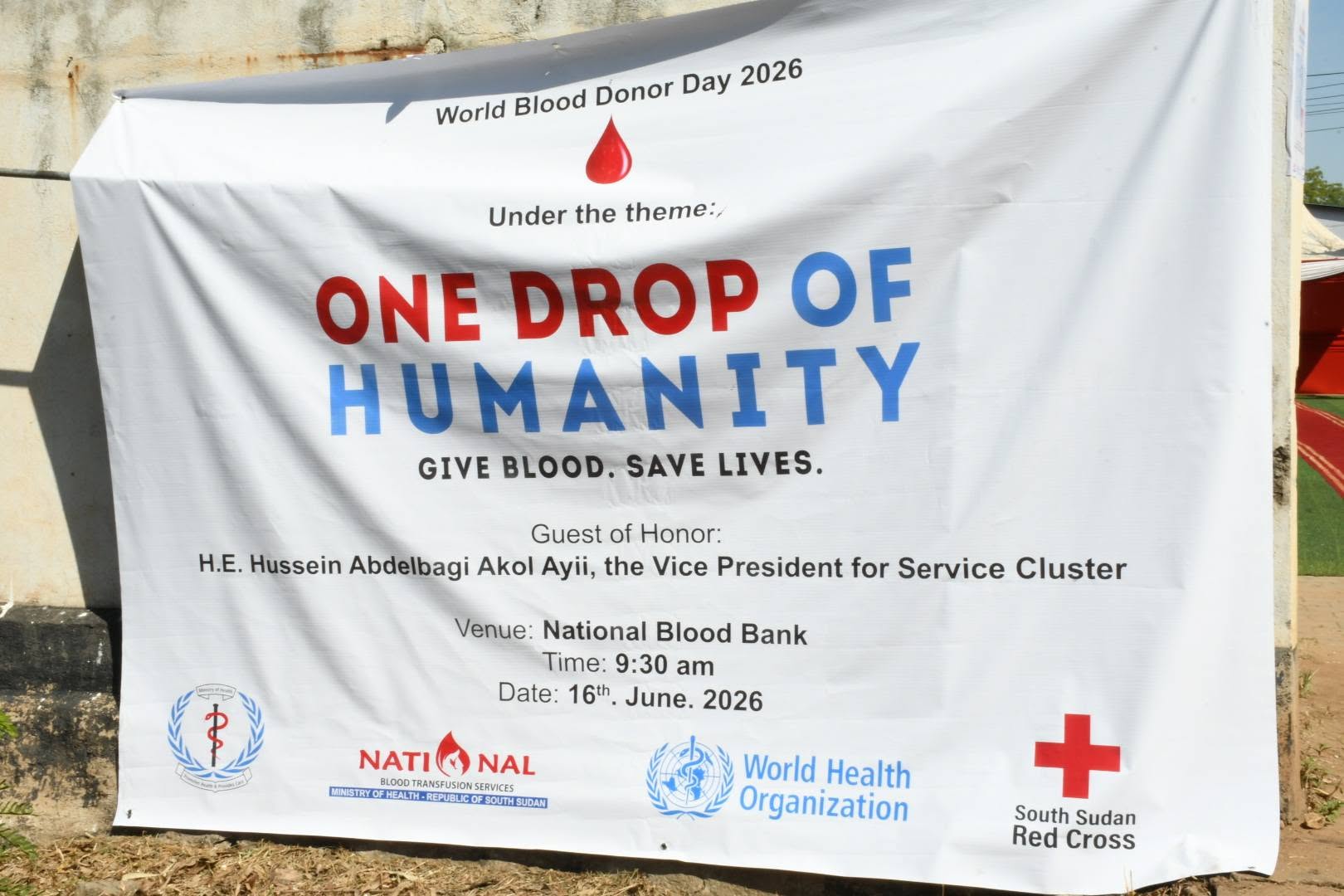
This year’s celebration was held under the theme: “One Drop of Humanity: Give Blood, Save Lives.”
Dr. Angelo described blood donation as a humanitarian act that saves lives every day, emphasizing that blood remains an essential medicine that cannot be manufactured.
“Blood is an essential medicine that is not manufactured in any factory. It can only come from human beings, and that is why voluntary blood donors are so important,” he said.
He thanked the National Ministry of Health, the South Sudan Red Cross, the Swiss Red Cross, the World Health Organization (WHO), and other partners for supporting blood transfusion services across the country.
Despite ongoing efforts, Dr. Angelo noted that South Sudan continues to face a significant shortage of blood. He explained that the country is expected to collect blood donations equivalent to at least one percent of its population to meet national demand, but current collections remain far below that target.
“We are far below the required blood units that can sustain the country. We continue to ask for the support of the government, partners, and the general public to ensure that we move away from family replacement donations and strengthen voluntary non-remunerated blood donation,” he said.
The NBTS currently operates fully functional regional blood banks in Juba, Wau, and Torit, but Dr. Angelo said expansion to other states remains limited due to resource constraints.
He appealed to government leaders and development partners to invest in infrastructure, equipment, and human resources to strengthen the country’s blood transfusion services.
Addressing the youth, he called on them to take an active role in saving lives through blood donation.
“You are the backbone of this country. Our forefathers donated their blood through war for us to have this nation. It is now our turn to donate blood to save lives,” he said.
Dr. Angelo also appealed for the completion and expansion of the National Blood Transfusion Service headquarters in Juba, saying a modern and fully equipped facility would improve the country’s capacity to provide safe blood to patients in need.
The event brought together officials from the Ministry of Health, development partners, humanitarian organizations, and voluntary blood donors who were recognized for their commitment to saving lives through blood donation.
World Blood Donor Day is observed annually on June 14 to raise awareness about the need for safe blood and to thank voluntary donors for their lifesaving contributions.