

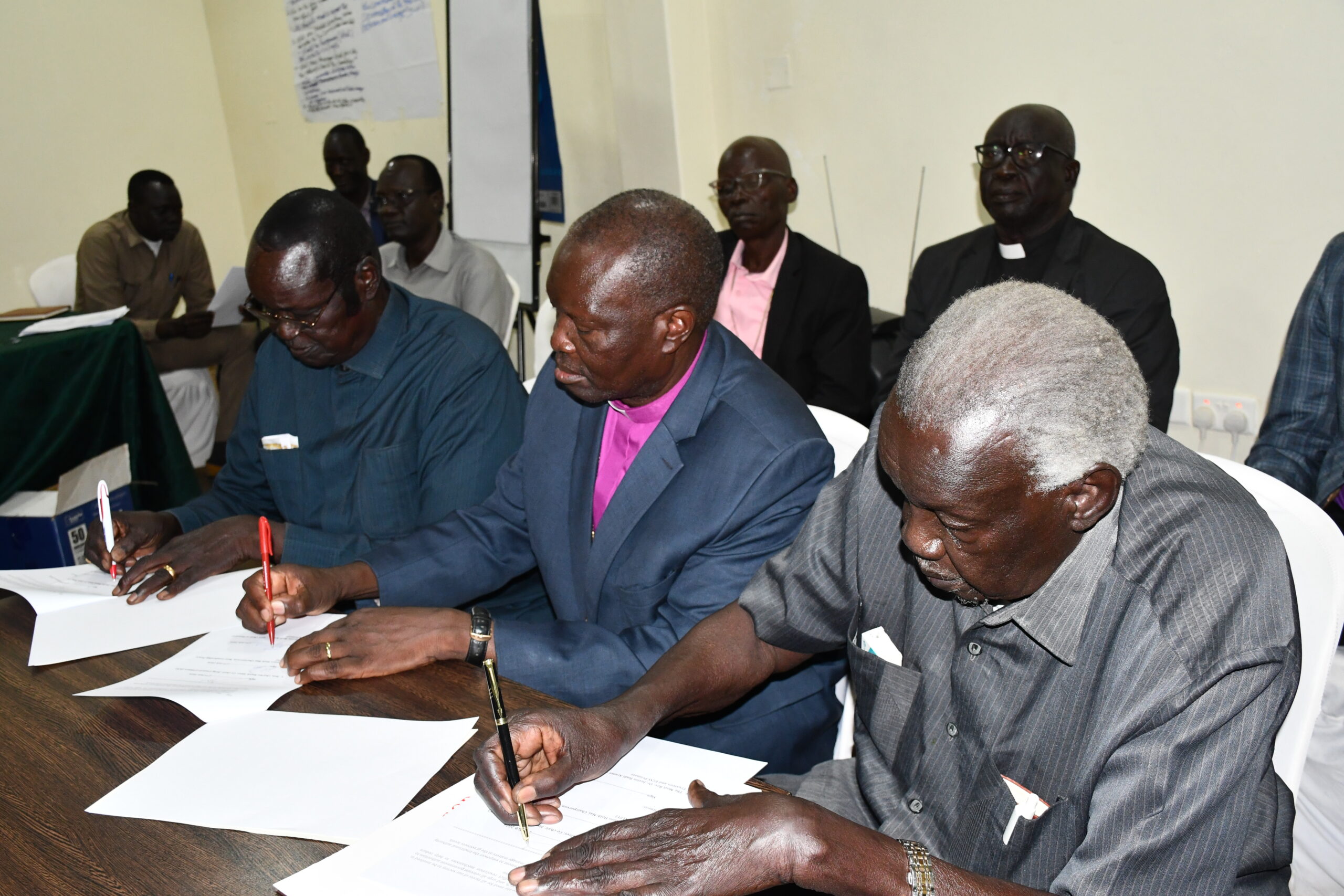
 Councils of Elders concluded a two-day peace and reconciliation dialogue in Juba with a joint communique affirming their renewed commitment to peaceful coexistence, unity, and healing among their communities. The dialogue, organized by the South Sudan Council of Churches (SSCC), brought together more than seventy elders to address historical grievances and strengthen grassroots peacebuilding efforts.)
By: Ginaba Lino
The Jieng and Naath (Nuer) Councils of Elders concluded a two-day peace and reconciliation dialogue in Juba with a joint communique affirming their renewed commitment to peaceful coexistence, unity, and healing among their communities. The dialogue, organized by the South Sudan Council of Churches (SSCC), brought together more than seventy elders to address historical grievances and strengthen grassroots peacebuilding efforts.
The meeting, described as “a turning point for national healing,” featured calls for unity, responsibility, and collaboration between communities and the church in restoring trust and stability across South Sudan.
Charles Majak Aleer, Co-Chair of the Jieng Council of Elders, praised the dialogue as a moment of transformation and a new chapter for the two communities.
“In my feelings, there is a great change of mindset and attitude towards each other,” Aleer said. “The spirit we have seen here is the spirit of people who are determined to bring peace to their people and allow South Sudan to rest from years of unrest.”
He cautioned against falling back into divisions and violence, emphasizing that peace must be safeguarded through vigilance and shared responsibility.
“We should not again fall into hostilities, killings, and miseries,” he said. “Those who thrive on tribalism and hatred have no future; let them go, because unity and peace will outlive them.”
Aleer also urged leaders to remain aware of how external interests can exploit national resources, drawing comparisons to the crisis in the Democratic Republic of the Congo.
“When you look at Congo today, you find foreign powers exploiting its resources under the cover of friendship,” he noted. “That example teaches us to be careful. Our riches should not be used to divide us but to develop our people.”
He concluded by thanking the SSCC for facilitating the dialogue, describing it as “a sacred space where truth and hope met.”
“The South Sudan Council of Churches has done its part by bringing us together,” he said. “Now it is upon us, the elders, to take this spirit of peace forward for the sake of our people.”
Speaking on behalf of Gen. James Hoth Mai, Chairperson of the Nuer Leadership Peace Forum, Secretary-General Gabriel Gai Riam expressed gratitude for the dialogue and conveyed his leader’s apologies for not attending due to illness.
“Our leader sends his warm greetings,” Riam said. “He wanted me to assure you that this meeting represents a new direction for our people and that we will not let you down.”
Riam reflected on the spiritual and moral test posed by the gathering, saying the dialogue had allowed both sides to open up and confront difficult truths.
“This has been a theological test,” he explained. “We came burdened by bitterness, but through these two days, we have purified our hearts. We found the discussions hard but healing, and we have come out stronger and united.”
He emphasized the importance of community engagement and collaboration with the church in rebuilding South Sudan.
“We have agreed that from now on, elders and church leaders must work hand in hand to prepare our people for peace,” Riam said. “We will send representatives to support the SSCC at the grassroots level, to spread the message of reconciliation.”
Riam called for continued dialogue among communities and leaders, warning that unresolved divisions could endanger national stability.
“South Sudan is burning, but let us thank God that it is burning while still young,” he said. “We can still rebuild. If we unite now, we will save our nation from collapsing like others before us.”
He concluded with an appeal to the church to maintain its unity and moral leadership.
“We look to the Church not only as a spiritual guide but as a foundation of our nationhood,” he said. “If church leaders stand together, the people will follow.”
The Most Rev. Dr. Justin Badi Arama, SSCC Chair of the Board of Trustees and Episcopal Church of South Sudan Primate, commended the elders for their courage in addressing sensitive issues and called for deeper spiritual healing across the nation.
“It is a great honour to stand before you, our elders, fathers, mothers, and brothers,” Archbishop Badi said. “On behalf of the church, I thank you for accepting our invitation and spending these two days with us in pursuit of peace.”
He reflected on the sacrifices made by past church leaders, including Bishop Paride Taban and Bishop Nathaniel Garang, noting that today’s challenges require even greater unity and wisdom.
“Our forefathers fought an easier battle because they knew their enemy,” he said. “But today, we fight among ourselves. This makes our struggle more difficult and calls for trust and forgiveness.”
Badi emphasized that true peace must begin with inner healing rather than political negotiations.
“You cannot share power and wealth when the wounds of the heart are still open,” he said. “Healing must come first. We must cleanse our hearts so that reconciliation can take root in our nation.”
He said the church would continue expanding its grassroots efforts, engaging local chiefs, youth, and women in peacebuilding processes.
“The real peace is not in Addis Ababa or Nairobi—it begins here, in dialogues like this,” he said. “We will take this process to the grassroots, bringing chiefs, elders, and young people together to define our future.”
Archbishop Badi concluded with a message of hope and unity, urging the elders to sustain communication and collaboration beyond the conference.
“You have started something powerful,” he said. “Let us keep this dialogue alive. The church and elders together can deliver a message of peace stronger than any political speech. May God bless South Sudan with lasting reconciliation.”
The two-day dialogue, facilitated by the South Sudan Council of Churches, is part of a wider grassroots peace initiative aimed at reconciling divided communities through open dialogue and collective responsibility. The joint communique signed at the close of the meeting affirmed both councils’ commitment to continued collaboration in peacebuilding, healing, and national unity