


Author|Ginaba Lino|CRN
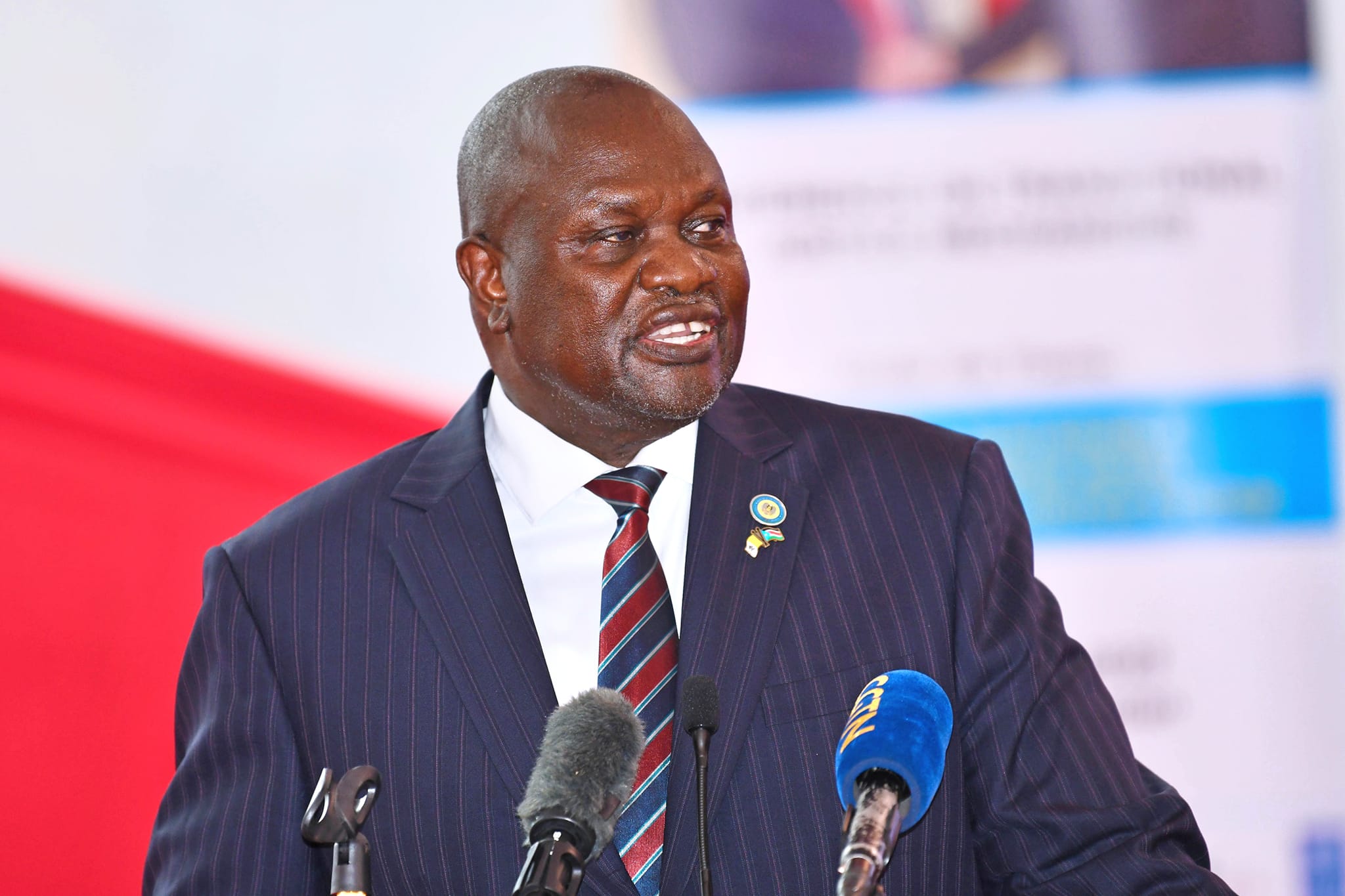
The Ministry of Justice and Constitutional Affairs has officially confirmed that Dr. Riek Machar Teny Dhurgon, First Vice President of South Sudan, along with seven other high-profile individuals, will face criminal prosecution in connection with the Nasir attack—a deadly assault that occurred between March 3rd and 7th, 2025, resulting in the deaths of over 250 people, including senior South Sudan People’s Defence Forces (SSPDF) officers and United Nations personnel.
The announcement was made by Minister of Justice, Hon. Dr. Joseph Geng Akech, during a press briefing on Wednesday, following the conclusion of a months-long investigation into what has been described as one of the most serious breaches of humanitarian and military law in the country’s recent history.
The Nasir attack was carried out by a militia group known as the White Army, a force historically composed of armed youth from the Nuer community. On March 3, 2025, the group launched a coordinated assault on an SSPDF barracks in Nasir, Upper Nile State.
The attack lasted several days, resulting in the death of Major General David Majur Dak, along with more than 250 SSPDF soldiers and two UN aviation personnel, whose helicopter was downed near the conflict zone.
Eyewitness accounts and satellite imagery later revealed scenes of widespread brutality, including targeted attacks on civilians, looting of humanitarian compounds, and the desecration of corpses—acts the government has deemed to be in violation of the Geneva Conventions and South Sudanese law.
According to Justice Minister Geng Akech, the investigation implicated several senior members of the Sudan People’s Liberation Movement-in-Opposition (SPLM-IO), linking them to the planning and execution of the attack.
Among them is Dr. Riek Machar, who is accused of coordinating and directing military operations related to the assault, in his capacity as the SPLM-IO’s political and military leader.
“This incident represents a gross violation of international humanitarian law and the rights of the South Sudanese people. The rule of law must prevail,” said Dr. Kengakech.
A special investigation committee established by the Ministry interviewed 83 individuals over a five-month period. The findings led to the indictment of 21 suspects, of which 8 individuals are currently under arrest and formally charged,13 remain at large, and 76 were released due to insufficient evidence.
The eight individuals currently in custody and set to face trial are, Dr. Riek Machar Teny Dhurgon – First Vice President of South Sudan is under house arrest since March this year.
Others are Mr. Puot Kang Chol – Minister of Petroleum, Lt. Gen. Gabriel Duop Lam – Senior SPLM-IO commander, Mam Pal Duop – Political figure affiliated with SPLM-IO
Gatwich Lam Poch, Brig. Gen. Camilo Gatmai Kel, Madin Riek Yak – Senior military aide Dominic Gatgok Riek – Logistics officer, all eight have denied the charges leveled against them.
Minister Akech confirmed that the case will proceed to trial before a competent South Sudanese court, with the prosecution preparing to present evidence to prove the charges beyond reasonable doubt.
“The proceedings will strictly adhere to South Sudanese law and international standards for fair trials,” said the Minister.
In a bid to ensure transparency and public accountability, the Ministry has announced that both the opening and closing sessions of the trial will be open to accredited media.
The Minister urged restraint from public commentary, stating that the case is now sub judice, meaning it is under judicial consideration, and therefore cannot be debated in the media, diplomatic channels, or public forums.
“Those who commit atrocities—regardless of rank or political influence—will be held accountable,” Dr. Akech said. “The people of South Sudan deserve peace. The victims and their families deserve justice. This government will uphold that promise.”
While the announcement has stirred domestic reactions, international observers, including the United Nations Mission in South Sudan (UNMISS) and regional peace monitors, have yet to issue official statements. Analysts say the trial could have significant implications for the Revitalized Peace Agreement and the fragile transitional government.
As the nation awaits further developments, the focus now turns to the courts, where one of the most politically sensitive trials in South Sudan’s history is set to begin.