


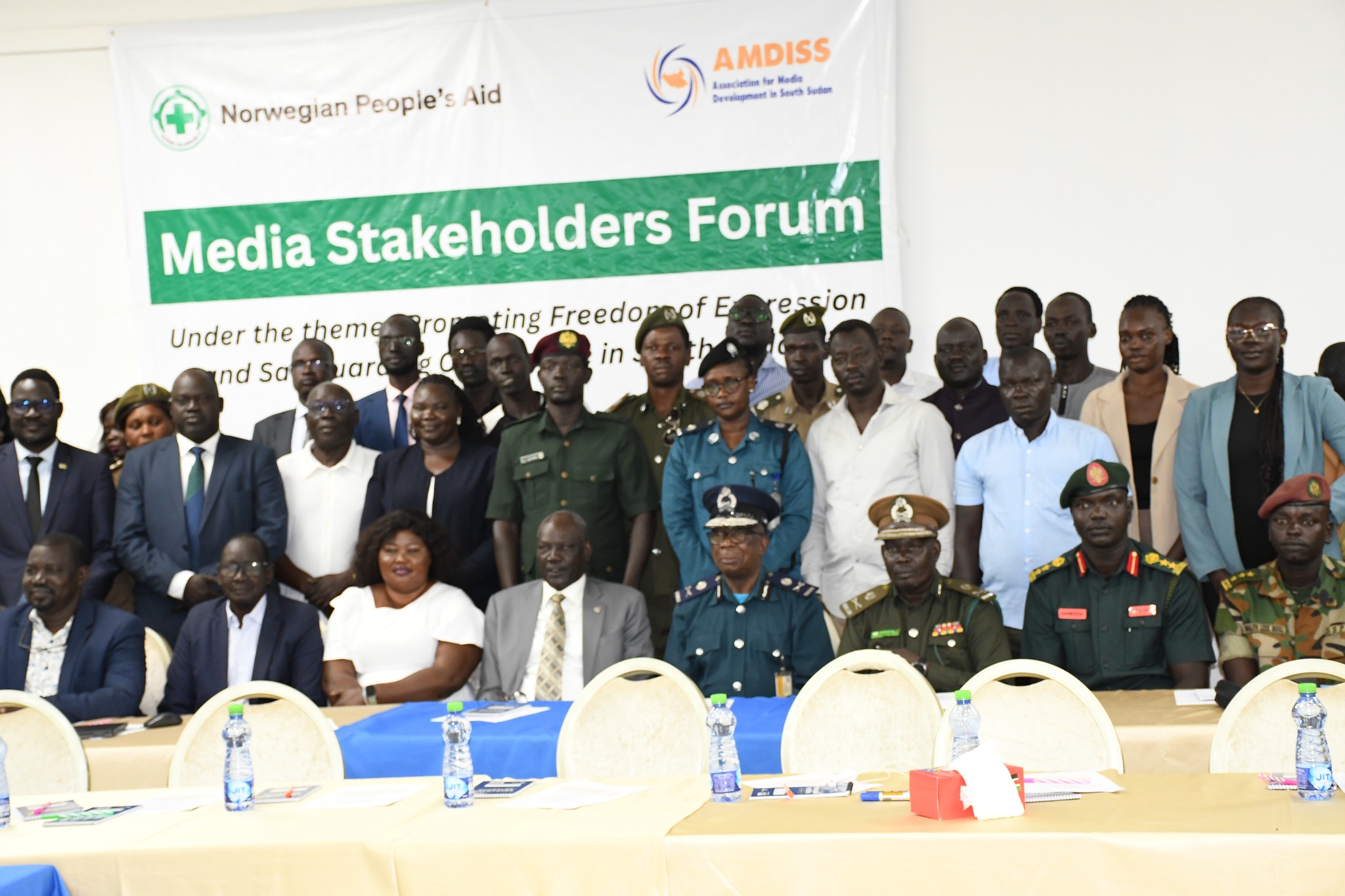
Media, security organs and civil society stakeholders gathered in Juba for a two-day Media Stakeholders Forum on Freedom of Expression and Civic Space, with renewed calls for collaboration, protection of journalists, and the strengthening of democratic values in South Sudan.
The Media Stakeholders Forum organized by AMDISS concluded on Wednesday with support from NPA, bringing together media practitioners, civil society actors, government representatives, and development partners to explore actionable strategies for promoting media freedom and expanding civic space in South Sudan.
In her opening remarks, Josephine Achiro, Chairperson of the Executive Board of the Association for Media Development in South Sudan (AMDISS), emphasized the central role of freedom of expression and civic space in building a democratic and inclusive society.
“Every day we meet, we keep freedom of expression and civic space at the forefront of our minds because it is a critical part of who we are—as a nation, as a people, and as journalists,” she said.
Achiro further urged the Ministry of Information to continue working in partnership with AMDISS to support journalists in their pre- and post-election coverage efforts.
She also appealed for the re-opening of the Media Development Institute (MDI) AMDISS’s training wing which has long provided essential capacity-building programs for journalists across the country.
“We want to prepare a ground where everybody is free to express themselves, and we want to ensure open civic space—so that anyone with an opinion or a voice can be heard,” added Ayaa Irene, Director of AMDISS.
Ayaa stressed that while progress has been made, harassment and intimidation of journalists continue, highlighting the need for ongoing advocacy and collective action to safeguard press freedom in South Sudan.
“Freedom of the press and expression is not handed to us on a silver plate. That’s why we, as media stakeholders, must stand together and keep pushing for these rights,” she said.
Sapana, an AMDISS official, addressed the importance of journalist accreditation, stating that the process helps promote ethical journalism and protects the profession from misinformation and disinformation.
“We only accredit journalists who are qualified and working for credible media houses, as well as certified freelance journalists and media trainers. Accreditation is issued to individuals, not organizations. This gives them access to government events and reinforces professional standards,” he explained.
Jackline Nasiwa, a prominent human rights activist, emphasized that a vibrant civic space is essential for holding governments accountable and protecting human rights.
“If we truly want a democratic society, we must respect civic space. It allows citizens to gather, express themselves freely, and demand accountability from their leaders. Civic space is for everyone—it drives reform and societal transformation,” she said.
Garang Ateny, Acting Spokesperson of the South Sudan People’s Defense Forces (SSPDF), committed to greater access for independent media to cover official activities.
“Going forward, we will allow independent media to cover our events. SSBC will not be the only media invited—we welcome other journalists as well. Of course, some internal meetings remain off-limits, even to SSBC, but those are exceptions,” he clarified.
Major General James Monday, Spokesperson for the South Sudan National Police Service, recognized ongoing challenges but pointed to positive developments.
“Civic space requires security. While pressure exists globally, South Sudan has made progress. We now have legal frameworks that protect freedom of expression and media rights, and this deserves acknowledgment, “he said.