

 have launched a $2.5 million flood resilience project in South Sudan, aimed at protecting vulnerable communities from the escalating impacts of climate change.)
By Otto Abut | Juba, August 19, 2025
Japan and the UN Refugee Agency (UNHCR) have launched a $2.5 million flood resilience project in South Sudan, aimed at protecting vulnerable communities from the escalating impacts of climate change.
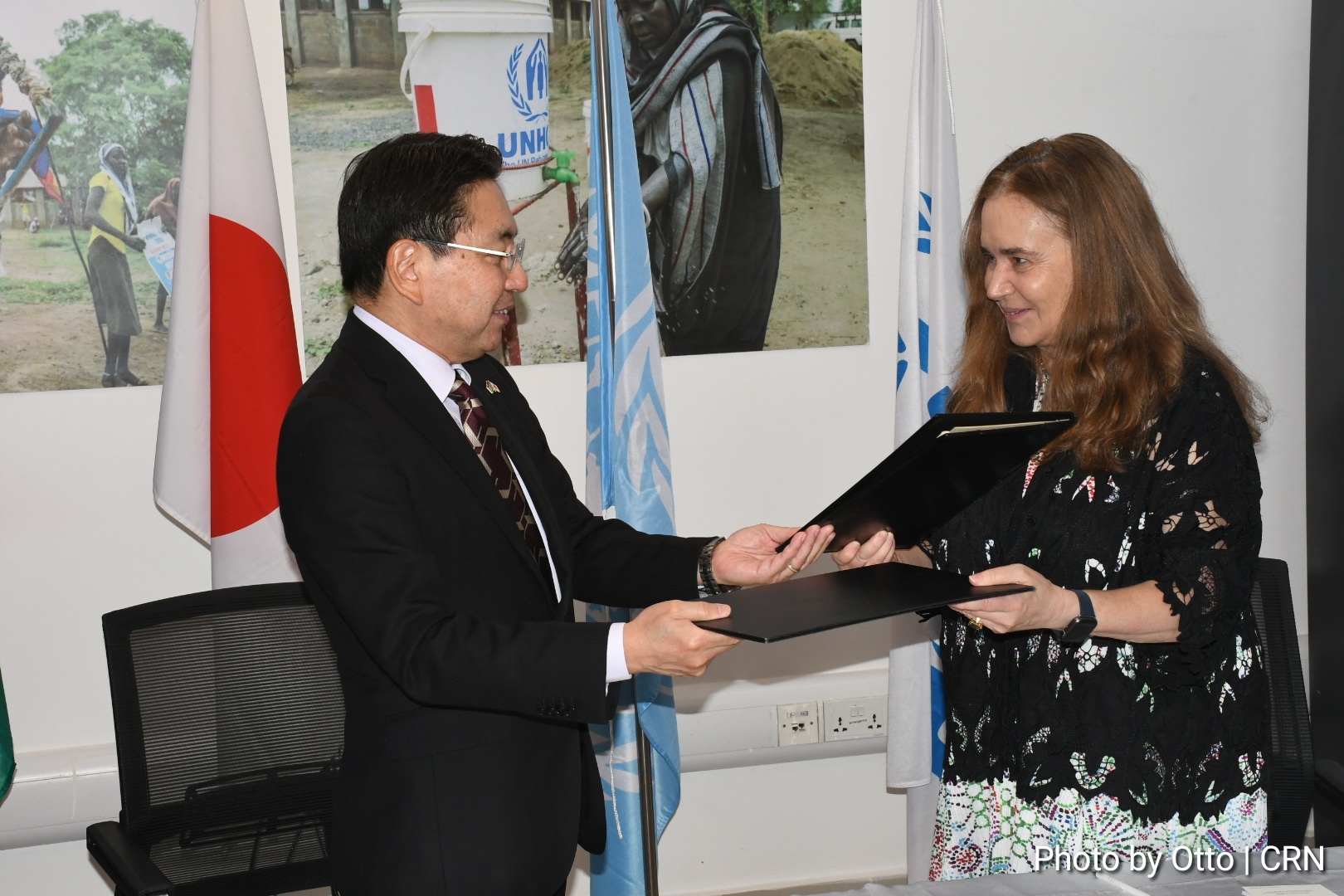
The agreement was signed on Tuesday, August 19, 2025, at the UNHCR office in Juba, in the presence of the Ambassador of Japan to South Sudan, Odagiri Toshio, Under-Secretary in the Ministry of Environment and Forestry, Joseph Africano Bartel, and UNHCR Representative Marie-Hélène Verney.
The two-year initiative, implemented by UNHCR in partnership with the World Food Programme (WFP), will focus on strengthening early warning systems, building flood-resilient shelters and infrastructure, and promoting climate-smart agriculture, including solar-powered irrigation and agroforestry
Ambassador Odagiri described the project as a critical step in addressing South Sudan’s frequent and devastating floods, which have displaced thousands and disrupted livelihoods.
“Today, we are taking a significant step forward in addressing this urgent challenge by signing this Flood Resilience Project agreement,” he said.
He emphasized that the initiative aligns with Japan’s global commitment to disaster risk reduction through the Sendai Framework (2015–2030) and reaffirmed Japan’s pledges made at the 2023 Global Refugee Forum.
“This project is more than just a financial investment; it is a commitment to building a stronger, more resilient South Sudan,” he added, while also urging the government to fully implement the peace agreement and restore national stability.
UNHCR Representative Marie-Hélène Verney said the project will directly benefit more than 25,000 people in Northern Bahr el Ghazal and Warrap states — including refugees, internally displaced persons (IDPs), returnees, and host communities.
“Climate change can be devastating, but it also provides an opportunity to adapt and build resilience,” said Verney. “This initiative aims to strengthen unity and cooperation at the community level.”
She highlighted the importance of community-based early warning systems, noting that local knowledge is key to anticipating floods and managing risks.
The program also includes the construction of 500 flood-resistant shelters and the rehabilitation of waterfront areas in Northern Bahr el Ghazal, a region severely affected by blocked waterways and seasonal flooding.
Speaking on behalf of the government, Under-Secretary Joseph Africano Bartel praised Japan as a “true partner of change and development,” highlighting Tokyo’s recent donation of over 30 waste management trucks and longstanding contributions to the health and education sectors.
“We are grateful for the strong friendship with the Government of Japan. What they are contributing now will complement our national efforts and help build resilience for our people,” Bartel said.
He also commended UNHCR’s decades of support, dating back to its assistance for South Sudanese refugees in 1972.
“Today, more than 2.5 million people remain displaced inside South Sudan. Others are returning from neighboring countries. This project will help us address both climate and conflict-induced displacement.”
With climate change and conflict continuing to threaten communities across South Sudan, the initiative marks a timely and strategic intervention to support recovery, resilience, and peacebuilding.