

 Fund. The project aims to promote small-scale farming and improve food security among vulnerable households.)
By: Ginaba Lino
Over 1,200 women and youth in Luri and Rajaf Payams of Central Equatoria State are set to benefit from a new agriculture initiative funded by the India, Brazil, and South Africa (IBSA) Fund. The project aims to promote small-scale farming and improve food security among vulnerable households.
The project, implemented by Oxfam and the United Nations Development Programme (UNDP) in partnership with the State Ministry of Gender, Child and Social Welfare, targets young mothers, persons with disabilities, survivors of gender-based violence (GBV), and households suffering from severe food insecurity.
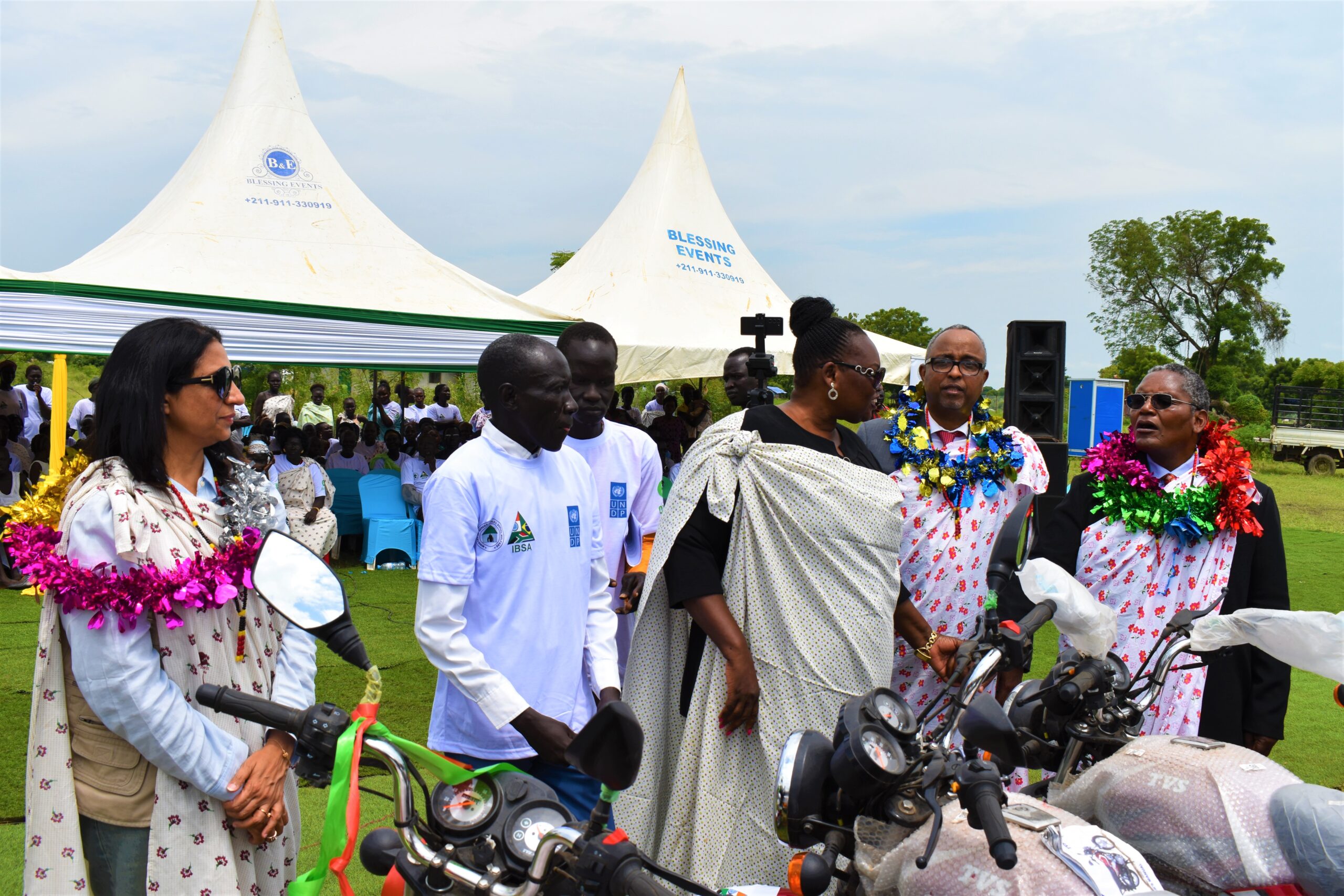
As part of the official launch, five farming groups received agricultural inputs and equipment to help kick-start the project. Beneficiaries will also gain access to solar-powered irrigation systems, boreholes, water tanks, and training on modern farming techniques including climate-smart agriculture and digital marketing.
Speaking on behalf of the beneficiaries, Paska Jane Zachariah from Rajaf Payam expressed her appreciation for the support, citing improved security and access to water as life-changing improvements.
“We’re happy because our farms are now protected from animals that used to destroy our crops. The fencing and the water piping system from the river mean we can farm year-round. I’m proud to work with my hands, earn income, and pay school fees for my children. I won’t die of hunger anymore,” said Paska.
Executive Chief of Rajaf Payam, Merino Pitia, encouraged beneficiaries not to limit themselves to small-scale farming but to aim for large-scale agriculture that could feed the entire state and beyond. However, he raised concerns about land grabbing, which he said is limiting farming expansion as land is increasingly claimed by individuals from urban areas.
Hon. Zendia Aluzaya, State Minister of Gender, Child and Social Welfare, welcomed the initiative and praised the resilience and hard work of women and youth. She emphasized their potential to contribute significantly to the state’s development.
“Women and youth are the backbone of this nation. With unity and hard work, you can transform this state through agriculture,” she said.
Hon. Zendia also urged the farmers to use their training wisely, particularly in understanding climate variability, such as knowing which crops require more or less water and when to plant them.
“Climate change is real. The more you understand your environment, the better choices you’ll make in farming,” she added.
The IBSA-funded project is designed not only to tackle immediate food insecurity but also to lay a foundation for long-term resilience and economic empowerment. With the introduction of solar irrigation, modern tools, and ongoing capacity-building, the program aims to create a sustainable model for smallholder farming that can be replicated across South Sudan.